
Mar
Ivermectin and Fenbendazole Together: Can You Take Both?
Table of Contents
If you’ve spent any time lately on health and wellness forums, you’ve undoubtedly seen ivermectin and fenbendazole come up in the same conversations. Sometimes, in the same way. People sometimes talk about them as if they are the same thing. They can’t be switched out. But there is a valid reason why people are mixing them, and it has to do with how these two drugs work in different ways.
A lot of people are asking the same question. They want to know if they can take both at the same time. Is it safe? Does it make sense? What should I do if I’m most likely to do it?
This article gives you the right answer. That means going over how each prescription works, what the combo truly does, where the risks are, what the research shows, and what you need to know about binders before you take each one. Let’s start with the basics.
What Are Ivermectin and Fenbendazole? A Quick Primer
Both of these are medicines that kill parasites. That’s where the similarities end.
Ivermectin, a macrocyclic lactone, has been used in medicine for people since the 1980s. The World Health Organization says it is an important medicine, and the FDA says it can be used to treat human onchocerciasis and strongyloidiasis. You may know about it from other uses. It became very controversial during COVID-19 and has gotten a lot of attention in the realm of off-label cancer research. There is more information about that below.
Fenbendazole is a kind of benzimidazole. It is the active ingredient of two well-known dewormers for pets, SafeGuard and Panacur. No pharmaceutical company has requested FDA approval for human use yet, so it isn’t approved for human use. This doesn’t mean it didn’t pass human testing. There is no financial need to pay for the regulatory process because it is cheap and not protected by a patent. But the FDA has approved mebendazole and albendazole, two of its chemical cousins, for use in people. This gives researchers a good idea of how safe they are.
So, one veterinary treatment has a clear safety profile but no approval for use in people, and one human pharmaceutical that the FDA has approved. Both of them kill parasites. They are both getting more attention than they should have. This is what makes the mix interesting.
How Each Drug Works?
The reason behind the combination is this. Fenbendazole and ivermectin not only work in various ways, but they also target parasites at different points in their life cycle. Once you know it, the combo idea makes sense.
Ivermectin: The Nervous System Attack
Ivermectin blocks the “on” switch in a parasite’s nervous system. In more detail, it binds to glutamate-gated chloride channels in the muscle and nerve cells of invertebrates. When those channels are forced open, chloride ions flow in, the cells become hyperpolarized, and the parasite is paralyzed. It can’t move. It can’t eat. It can’t have kids. It dies.
Mammals don’t have the same kind of glutamate-gated chloride channels, which is why ivermectin is so useful and safe for people when taken in the proper amounts. The drug mostly passes through the body without having the same effect, but it hits the parasite’s target with a high degree of accuracy.
Ivermectin is fat-soluble, which means it can go into fatty tissues and kill parasites that live there. The liver’s CYP3A4 enzyme pathway breaks it down, and it normally takes a few hours to be absorbed. There is also a second, smaller peak from enterohepatic recycling.
Fenbendazole: The Structural Attack
Fenbendazole takes a very different approach. Instead of going for the parasite’s nervous system, it goes after its cellular scaffolding.
Microtubules are important parts of all cells, even those of people and parasites. Think of them as the parts of the cell that move nutrients in and out. Fenbendazole binds to beta-tubulin, a protein that is needed to make such microtubules. When fenbendazole stops that protein, the framework can’t be put together. The parasite dies after it can no longer divide, take in glucose, or keep its shape.
Researchers are interested in fenbendazole for cancer research because it can damage microtubules, which are necessary for cancer cells to divide. A lot of chemotherapeutic drugs do precisely that: they mess things up. It is quite interesting to read about a preclinical scientific study on this topic. The mechanism is true, but it hasn’t been tested on people yet in clinical trials.
One key thing to remember is that fenbendazole doesn’t dissolve well in water. A lot of it doesn’t go into the bloodstream until it’s taken with fat. This is not a tiny point; check the section below for further information regarding binders.
Are you looking for a safe and Reliable supply of Ivermectin? Don’t worry, we’ve got you covered.
Click here to explore these products ->
Ivermectin vs. Fenbendazole: Side-by-Side Comparison
| Ivermectin | Fenbendazole | |
|---|---|---|
Drug class | Macrocyclic lactone | Benzimidazole |
How it works | Paralyzes parasite nervous system via chloride channel disruption | Destroys parasite cell structure by blocking microtubule formation |
Primary target | Parasite nerve and muscle cells | Parasite cellular scaffolding and glucose uptake |
FDA status (humans) | Approved for strongyloidiasis and onchocerciasis | Not FDA-approved for human use |
Absorption | Good: It peaks at 4 hours, enhanced by fat | Poor water solubility: Requires fat source to absorb |
Liver metabolism | CYP3A4 enzyme pathway | CYP3A4 and FMO enzymes: Same pathways as ivermectin |
Half-life | ~18 hours (longer with tissue binding) | ~24 hours for parent compound |
Binder needed? | Beneficial: Fatty meal improves absorption | Essential: Negligible absorption without fat |
Off-label research interest | Cancer, antiviral, and immune modulation | Cancer (tubulin disruption), antiparasitic protocols |
Veterinary use | Yes: Widely used in livestock and pets | Yes: Primary approved use is veterinary |
Know more about Fenbendazole dosage for humans ->
Why Do People Take Ivermectin and Fenbendazole Together?
Once you know how things work, the logic is easy to follow. Ivermectin affects the neurological system. Fenbendazole affects the cells. They’re attacks from two sides that work together to hit different biological targets at the same time.
This is a common way to treat mixed infections in veterinary medicine. When an animal has parasites that are weak to distinct medications, using both drugs makes it more likely that all of the parasites will be killed and less likely that any one parasite would survive drug resistance. Research involving non-human primates demonstrated a significant reduction in fecal egg counts when the combination was administered for concurrent Strongyloides and Trichuris infections.
The combination is used off-label in humans in two primary ways. First, as a broad-spectrum antiparasitic regimen for those who suspect a complicated parasitic infection, especially post-travel or when conventional testing has yielded equivocal results. Second, as part of the cancer research perspective that came after the Joe Tippens narrative and the scholarly interest in both medications as possible additions to standard cancer treatment.
The Journal of Orthomolecular Medicine (2024) published a peer-reviewed protocol written by researchers, including FLCCC’s Dr. Paul Marik. It described a combination framework that used ivermectin, fenbendazole or mebendazole, and a few nutraceuticals. This provides the combination a more formal academic basis than it had before, but it still doesn’t meet the proof level needed for clinical advice.
Bottom line: In short, the combination makes sense from a pharmacological point of view. Two distinct methods, enhanced coverage, and justification derived from established veterinary practices. What we need is data from controlled human trials that indicate it’s more effective than either medicine alone, and what the best dose for people is.
Binders: The Most Important Part Nobody Talks About
A lot of fenbendazole doesn’t go into your bloodstream if you don’t eat any fat with it. This is the part of any fenbendazole procedure that many don’t pay enough attention to. If you skip it, you lose a lot of the dose.
Fenbendazole doesn’t dissolve well in water; it needs fat to get past the intestinal wall. The fat works like a carrier, drawing the medicine through the gut lining and into the lymphatic system. Most of the dose goes through without being absorbed if you don’t take it.
Fat is also good for ivermectin, although not as much. A fatty meal makes it easier for the body to absorb, not easier for it to be absorbed. Studies on people have shown that taking ivermectin with a high-fat meal raises blood levels significantly more than not eating at all.
The Three Main Fat Sources Used
| Fat Source | Best For | How to Use | Notes |
|---|---|---|---|
Extra Virgin Olive Oil (EVOO) | Fenbendazole absorption | 1-2 tablespoons taken with or just before the dose | Original Joe Tippens protocol; well-tolerated |
Vitamin E (succinate form) | Both drugs | 400-800 IU taken with the dose | Also in Tippens protocol; note: removed by Tippens in 2020 due to blood thinner interaction concerns |
High-fat meal | Both drugs | Take both drugs with or immediately after a meal containing healthy fats | Most practical option for daily use; avocado, eggs, nuts, olive oil work well |
Coconut oil or MCT oil | General absorption support | 1 tablespoon mixed into food or taken directly | Less studied specifically for this application, but fat is fat, it works on the absorption principle |
One critical rule: If the binder is meant to soak up things like activated charcoal, cholestyramine, or zeolite, you should never take it at the same time as your antiparasitic dose. Those will stick to your medicine before your body can absorb it, which means you will have wasted the dose. These binding agents are sometimes employed in parasite protocols to help with die-off symptoms, but they have to be taken at least two hours apart from the drug itself.
What Are the Real Risks of Taking Both Together?
The truth is that we don’t have any human clinical trial data on this combo. That’s not uncommon for off-label regimens; a lot of medicine happens outside of formal studies. But it implies that pharmacology and case reports, not controlled trials, shape the danger picture.
This is what the pharmacology says.
Shared Liver Metabolism
The liver’s CYP450 enzyme system, especially CYP3A4, is mostly responsible for breaking down both ivermectin and fenbendazole. Taking two medications that use the same metabolic pathway makes those enzymes work harder overall. Because the enzymes are busy processing both drugs at the same time, this could mean that one or both drugs linger in your system longer than they would on their own.
In real life, this is doable as long as your liver is working well. This is more important if you already have liver problems, are taking other drugs that also rely on CYP3A4, or are taking either drug in very high dosages. If you are on either treatment for a long time, it makes sense to keep an eye on your liver enzymes with a simple blood test.
Fenbendazole-Associated Liver Injury
There are case reports in the literature of drug-induced liver damage (DILI) in individuals who self-administered fenbendazole at elevated doses for prolonged durations. After quitting the medicine, liver enzymes returned to normal in all documented cases. This is a genuine risk, not just a theoretical one, but it seems to depend on the dose and can be reversed.
Ivermectin CNS Effects at High Doses
Ivermectin is safe for people to use at the doses that are approved. CNS symptoms like dizziness, confusion, and vision abnormalities are more common at greater doses, which some off-label cancer treatments use. Individuals possessing specific genetic variations of the P-glycoprotein transporter (MDR1/ABCB1) may exhibit heightened sensitivity. This transporter usually keeps ivermectin from getting through the blood-brain barrier.
Drug Interactions
You should be aware of how the two medications interact with each other. Ivermectin interacts with warfarin (a blood thinner), several HIV drugs, and other drugs that work on CYP3A4. Fenbendazole has less known interactions because there aren’t as many rigorous pharmacokinetic studies in people, but the shared liver route is the interaction to watch.
The practical bottom line: The basic fact is that most healthy persons can handle the danger of taking either drug at conventional antiparasitic doses for a set amount of time. If you use a lot of a drug for a long time or with other drugs that are broken down by the liver, you should talk to your doctor and keep a close eye on it.
The Cancer Research Angle: What the Science Actually Shows
This is where the conversation gets more complicated, and it’s important to be clear about what works and what doesn’t.
Both medications have received real scientific attention as possible cancer-fighting treatments. Both have released preclinical research demonstrating efficacy against cancer cell lines. Neither has an approved use for treating cancer in people.
Fenbendazole and Cancer
After Joe Tippens’ tale went viral, other cancer researchers became interested in fenbendazole. Tippens was told in 2016 that he had terminal non-small-cell lung cancer. He started taking fenbendazole, curcumin, and vitamin E succinate on his own, and three months later, his PET scan showed that he was cancer-free. One case doesn’t prove causation; he was also getting an experimental cancer vaccine, which could have had a role. But the narrative got people talking about genuine research.
The scientific basis is real. The way fenbendazole works to break down tubulin is the same way that other well-known chemotherapy medicines (taxanes, vinca alkaloids) work. Research conducted on cell lines and animal models has demonstrated its ability to impede tumor proliferation, induce apoptosis in cancer cells, and disrupt glucose absorption, a critical energy source for numerous malignancies. A 2021 case series in clinical oncology reported three individuals with genitourinary malignancies who exhibited full responses to fenbendazole. The 2024 Baghli/Marik study in the Journal of Orthomolecular Medicine suggested a formal methodology that combined it with ivermectin.
What we need are randomized controlled trials with people. Fenbendazole is still experimental for cancer until those things happen. It’s really interesting, being studied, but not yet proven.
Ivermectin and Cancer
There are many ways that ivermectin might be useful in cancer treatment: it might directly stop cells from growing, it might stop P-glycoprotein (which is involved in chemotherapy resistance), and it might change the immune system. A Phase I/II research at Cedars-Sinai Medical Center assessed ivermectin in conjunction with immunotherapy for metastatic triple-negative breast cancer (reported at ASCO 2025). The results didn’t reveal that there was a clear benefit to using both treatments together.
That outcome doesn’t mean that ivermectin can’t be used in cancer treatment; one little study isn’t enough to answer the question. But this is a vital piece of information: the excitement online is ahead of the clinical proof.
The honest summary: Both medications have reasonable biological pathways that could help fight cancer. Preclinical data are authentic and intriguing. There is no or only tentative human clinical proof. The medically sound way to look into this is to do it along with, not instead of, traditional treatment.
How People Are Taking the Combination: Practical Protocol Details
The most commonly referenced protocol in this space, based on the modified Joe Tippens/Marik framework, looks like this:
| Drug | Typical Dose Range | Frequency | With Fat? |
|---|---|---|---|
Ivermectin | 12-24mg (standard) up to ~1mg/kg for high-dose protocols | Once daily or 6 days on / 1 day off | Yes, Required for best absorption |
Fenbendazole | 222-500mg (standard) up to 1g for aggressive protocols | 6 days on / 1 day off (Tippens protocol) | Yes, Essential, poor absorption without fat |
Vitamin D | 2,500 IU (62.5 mcg) | Daily | Take with a fatty meal |
Bio-available curcumin | 600mg | Daily | Enhanced by fat/black pepper |
These doses come from published off-label methods and reports from people in the community, not from FDA-approved prescribing instructions. There is no recommended dose of fenbendazole for people. The permitted doses of ivermectin for humans are much lower than the high-dose procedures mentioned above. Anyone who is thinking about taking these doses should do so under the care of a doctor and have their liver function tested first.
The Tippens treatment has a “6 days on / 1 day off” schedule for fenbendazole, which is meant to lower the amount of work the liver has to do all the time. The one day off may lower the chance of liver enzyme levels going up over time.
Sourcing Ivermectin and Fenbendazole: What Matters
Not all sources are the same. A lot of people don’t know how important this is.
Ivermectin for people comes in pills with set doses. The most frequent amounts are 3mg, 6mg, and 12mg. Tablets for humans have set concentrations, production requirements, and dosing.
There are three ways to provide ivermectin to animals: as a paste, a pour-on, or an injection. Concentrations are all over the place; for example, a 1.87% horse paste has roughly 91mg of ivermectin per gram of paste, which makes it very hard to get the right dose. The paste also has excipients (fillers and preservatives) that are made for horses’ bodies, not for people to absorb through their GI tract.
Fenbendazole comes in capsules that are meant for people, and 150mg and 500mg capsules are typical. Many people in this field utilize SafeGuard and Panacur, which are the vet-branded versions (they have the same active component). However, they come with the same excipient warning.
When looking for these drugs, the most important things to ask are: Is this a product made for people? Is the dose per unit obvious and the same every time? Is the manufacturer open about who they are?
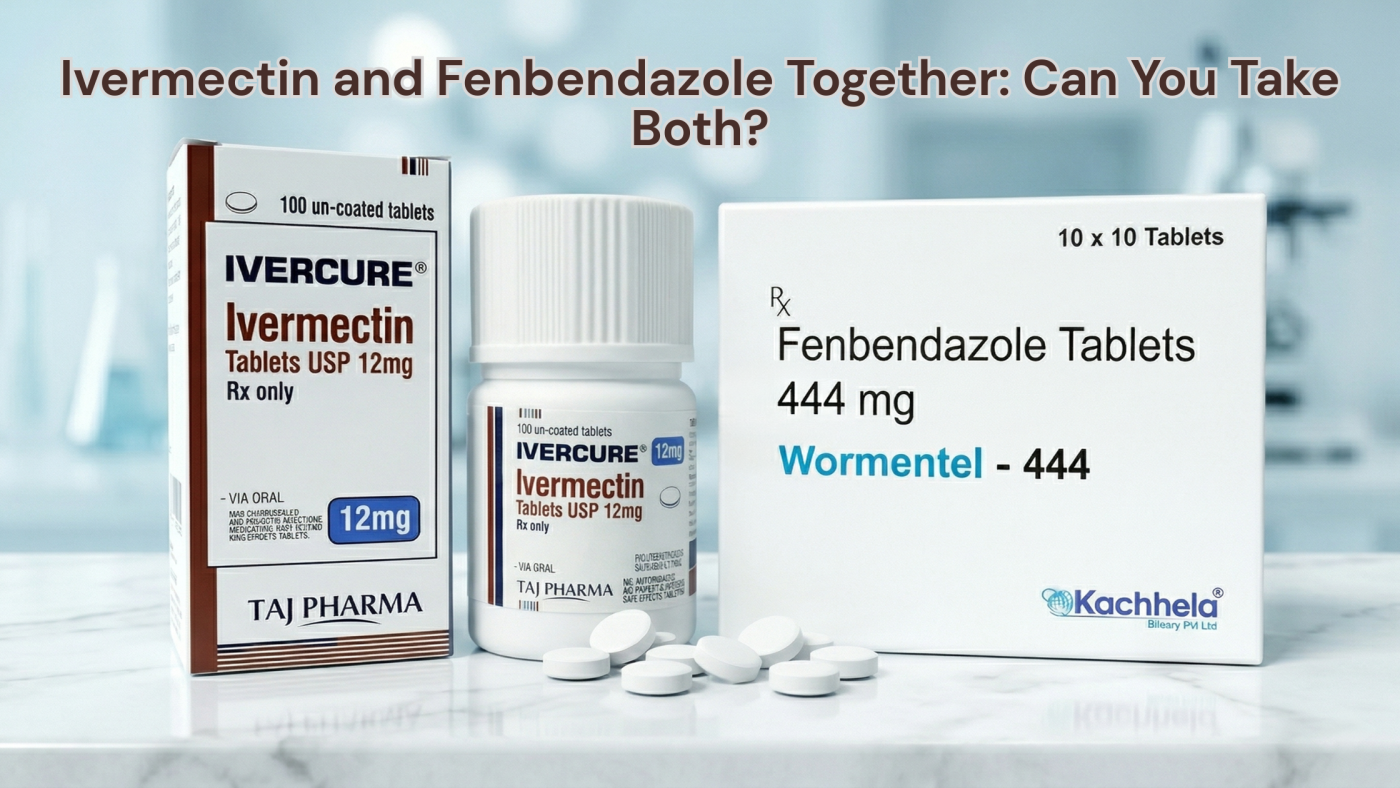
For US consumers, rxfarmacia.com sells human-grade ivermectin tablets (Ivercure 12mg and Iverotaj 12mg) and Fenbendazole (Wormentel 500mg).
View Ivermectin options at RxFarmacia.com ->
Frequently Asked Questions
Can you take ivermectin and fenbendazole at the same time?
You can take them on the same day, but it’s usually best to wait a few hours between doses to lessen the strain on the liver. The metabolism of both medications depends on CYP3A4 enzymes. Most healthy adults can take both at the same time without any problems, but it’s a good idea to space them out.
Which is better? Ivermectin or fenbendazole?
The comparison isn’t exactly right because they can’t be switched out. The FDA has approved ivermectin for use in people, and there is evidence of improved absorption. Fenbendazole works on a completely different mechanism and has been more effective in research on cancer cell lines. For antiparasitic use, the right one to employ relies on the parasite you’re dealing with because they all attack distinct species.
Do I need a prescription for ivermectin and fenbendazole?
Most jurisdictions in the US require a prescription for ivermectin, although a few states, like Arkansas, Idaho, and Tennessee, sell it without a prescription. Fenbendazole is not a prescription drug in the US and is not approved by the FDA for use in people. It is available as a veterinary product or in formulations for people through internet pharmacies.
What binder should I use with ivermectin and fenbendazole?
The original Tippens regimen calls for 1–2 tablespoons of extra virgin olive oil, which is the most popular type. A meal high in fat works just as well for everyday use. The important thing is fat, not where it comes from. Don’t take activated charcoal or other binding agents within two hours of either medicine. These will stick to the medications before your body can absorb them.
Are ivermectin and fenbendazole safe to take together?
Based on pharmacological reasoning and feedback from the community, the combination seems to be safe for most healthy adults at normal doses for a set amount of time. The primary hazards are cumulative liver load (since both medications utilize the same CYP450 enzymes) and fenbendazole-induced increase of liver enzymes at elevated doses. If you want to use either drug for a long time, it makes sense to test and keep an eye on your liver function.
How long should you take ivermectin and fenbendazole together?
There are no clinical guidelines for this since no clinical trials have tested the combination on people. For routine antiparasitic usage, courses are usually short and well-defined. The length of time for off-label procedures varies a lot. If you use these drugs all the time, it’s a good idea to check your liver function now and again.
What is the difference between ivermectin and fenbendazole?
Ivermectin is a macrocyclic lactone that stops parasites from moving by messing up their neurological system. Fenbendazole is a type of benzimidazole that kills parasites by breaking down their cellular framework and stopping them from taking in glucose. Different classes, methods, and target organisms are utilized together because they each cover a different biological weakness.
The Bottom Line
Ivermectin and fenbendazole are two different drugs that can’t be used in place of each other. In other words, they are biologically complementary, meaning they attack the same wide group of targets in two separate ways. That’s why the combination makes sense from a medical point of view and why it has been utilized in veterinary treatment for decades.
The combination is off-label for humans, not well-studied in formal trials, and is being utilized by a lot of patients, especially for complicated parasite infections and cancer treatment. The preclinical science is real. The clinical data in humans are preliminary. Most healthy adults can handle the dangers if they take the right amount for the right amount of time and pay attention to their liver function and fat-based absorption.
If you’re getting these drugs, you should look for human-grade versions with clear dosing. Veterinary products with different amounts of active ingredients and fillers made for animal physiology are not a good replacement.
For human-grade ivermectin and fenbendazole with Worldwide shipping:
Medical Disclaimer
This article is written for informational purposes only and does not constitute medical advice. Ivermectin and fenbendazole are not approved by the FDA for the uses described in this article. Consult a qualified healthcare provider before starting, stopping, or combining any medications.
