Mar
Fenbendazole is one of the more unusual stories in modern health culture. It’s a deworming drug for dogs and livestock that is off-patent and cheap, but not approved by the FDA for human use. Yet it’s become one of the most researched alternative health topics online, with labs in many countries studying it and thousands of people using it according to protocols they put together from forums, case reports, and a viral story about a man who says it helped him survive terminal cancer.
You probably don’t need permission if you’ve made it this far. You want to know the truth. You want to know what the right dose is, where the 222mg number comes from, if the cancer research is true, and how to use it safely. This is what this guide is for.
The truth is that there is no FDA-approved dose of fenbendazole for people. Instead, we have a mix of veterinary dosing data, limited off-label clinical observations, animal and in vitro research, and community-created protocols, with the Joe Tippens framework being the most important one for human use. We’ll talk about everything. This includes places where the evidence is strong, places where it looks good but isn’t complete, and places where it’s mostly theoretical.
By the end of this guide, you’ll know exactly how to figure out the right dose of fenbendazole for people, what the different protocols look like, and what the human-approved alternative in the same drug class looks like. This way, you can talk to your doctor about your options.
1. Why Fenbendazole Dosage for Humans Is a Complicated Question
A package insert comes with most drugs. It tells you the dose, the schedule, the clinical trial data, and the things that might make it unsafe. The package insert for fenbendazole was made for horses. The one at your local farm supply store is set up for an animal that weighs 1,200 pounds.
The drug didn’t fail human testing, which is why there isn’t an official human dosage framework. It’s because no drug company has ever asked the FDA for permission to use fenbendazole in people. The drug is no longer protected by a patent, so any generic company can make it. It is also cheap. Running the multi-year, multi-million-dollar trial needed to get approval won’t make any money. So the tests haven’t taken place. Not in any way that would create a dosing standard that meets regulatory standards.
Mebendazole and albendazole, which are very similar to it chemically, did go through that process and are safe for people to use. They work in the same way. They are both in the same drug family. And that’s actually important to know when trying to figure out how much fenbendazole to give a person: by comparing it to drugs that are almost the same.
That covers the rules and regulations. Before we talk about how much fenbendazole you should take, let’s first look at what it actually does.
2. What Fenbendazole Actually Is
Fenbendazole is a benzimidazole anthelmintic, which means it is part of a group of drugs that kill helminths, which are parasitic worms. Veterinarians have been using it since the early 1970s under brand names like Panacur and Safe-Guard.
Mebendazole and albendazole, which are both approved for use in people, can treat a variety of intestinal worm infections, such as pinworms, roundworms, whipworms, hookworms, and tapeworms. The drug class has a long and well-established safety record in human medicine; it’s just that fenbendazole specifically hasn’t been the subject of formal human approval.
Fenbendazole is interesting for more than just its use against parasites. It’s also interesting because of what it does at the cellular level, and research suggests that these cellular effects could be important in other situations besides worm infections. Section 9 has more information on that.
3. How It Works: The Mechanism That Matters
Microtubules are the scaffolding system that every cell, whether it’s a parasite, a tumour, or your own body, needs. Microtubules are the parts of a cell that keep it organised. They are the paths that nutrients travel on, the structure that keeps the cell’s shape, and most importantly, the machinery that separates chromosomes when a cell divides.
Fenbendazole sticks to a protein called beta-tubulin, which is what makes up the microtubule tracks. The scaffolding can’t put itself together right when fenbendazole binds to it. The cell’s structure breaks down. It can’t be split up. It can’t move glucose. This is deadly for parasites because the worm basically falls apart from the inside out.
This is why fenbendazole has gotten attention for uses other than killing parasites. Cells that cause cancer keep dividing. They rely significantly on the proper functioning of microtubules. Fenbendazole does exactly that, and it does it in a way that is very similar to how some chemotherapy drugs (like taxanes and vinca alkaloids) work. Fenbendazole, on the other hand, attacks the process from the other side by breaking up tubulin polymerisation instead of stabilising it. Different angle, same goal.
That mechanism is what links the cancer research angle to the antiparasitic dosing framework, and it’s why you should learn about both before you choose a dose.
4. Fenbendazole Dosage for Humans: What the Evidence Actually Shows
There is no single established human dose of fenbendazole. What exists is a small body of evidence from which dosing estimates are derived. Here’s what that evidence actually consists of.
Veterinary-to-Human Extrapolation
For conventional antiparasitic treatment in dogs, fenbendazole is usually given at a dose of 25 to 50 mg/kg. That range would be very high for people; the dose for people based on body surface area scaling would be much lower.
Most people who take fenbendazole off-label in people talk about a dose that is closer to 2–5 mg/kg. This value is based on data from animals and how mebendazole is dosed in people. For an adult who weighs 70 kg, 2.2 mg/kg is roughly 154 mg. The 222mg Tippens dose is close to this range and is now the standard point of reference.
The Mebendazole Parallel
For people, mebendazole, which is a benzimidazole that has been licensed for use in humans, is usually given in doses of 100 to 500 mg. The 222mg dose of fenbendazole is just in the middle of that range. This comparison makes sense. It doesn’t show that 222mg of fenbendazole is safe, but it does demonstrate that the range isn’t random; it’s based on how the most chemically similar medicine that has been licensed for use in humans is actually used.
Off-Label Clinical Reports
Numerous case reports and limited clinical series have recorded the use of fenbendazole in humans, predominantly among cancer patients who self-administered the medication as an additional therapy. These publications include safety observations at the 222mg level but are not intended to demonstrate efficacy. They are real-world data, not evidence that has been manipulated.
5. The Joe Tippens Protocol: Where the 222mg Number Comes From
Joe Tippens was diagnosed with small-cell lung cancer in 2016. It is one of the most aggressive types of cancer, and the prognosis was only a few months. A veterinarian suggested that he take fenbendazole when he was in a clinical trial. At the time, researchers were looking into its possible cancer-fighting capabilities. He started taking it with the trial treatment and a mix of supplements that included curcumin, vitamin E succinate, and CBD oil.
When Tippens put his story online in 2019, his scans were normal. The cancer that had spread to most of his body, including his neck, bladder, pancreas, stomach, and bones, was said to be gone.
He said that was because of the fenbendazole therapy. The medical community properly pointed out that he was involved in a research trial for a new medicine that boosts the immune system. It’s really impossible to say what triggered his remission based on just one case. But the tale went viral, along with the exact procedure he used: 222mg of fenbendazole three times a week, along with the nutrients he talked about.
Why 222mg specifically?
The 222mg number comes from the Panacur C canine dewormer medicine. Each single-serving sachet has exactly 222mg of fenbendazole in it. It became the de facto unit since it is a dose that can be measured and bought. Tippens only used one packet. That was the plan.
It’s important to be clear about what this means: the 222mg dose is a convenience dose that was set by the manufacturer, not one that was calculated by a doctor. Based on mebendazole parallels and veterinarian scaling, it falls within a tolerable range. But the exact quantity is a little random, and it makes sense that different body weights would call for varied doses.
The Full Tippens Protocol
- Fenbendazole: 222mg for three days, then four days off (most often Friday, Saturday, and Sunday)
- Curcumin: 600mg per day (in a form that the body can use)
- Vitamin E: 400 to 800 IU of succinate every day
- Tippens then changed this part in interviews to say that CBD oil should be taken every day at 25mg.
In this treatment, the supplements aren’t just for show; each one has its own studies showing that it helps fight cancer. Tippens has also made it clear that he thinks the combination, not just fenbendazole, is what matters. The protocol is more than just the fenbendazole dose.
6. Fenbendazole Dosage by Weight for Adults
The most clinically defensible way to think about fenbendazole dosage for humans absent a formal approved dose is weight-based, using the same scaling principle that governs mebendazole and veterinary benzimidazole dosing. The table below provides the framework.
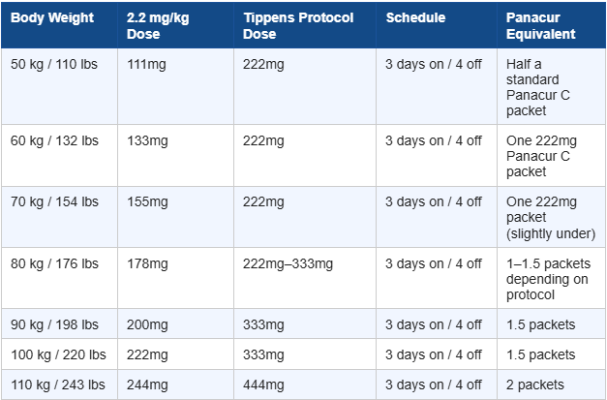
Here are a few things to keep in mind with this table. First, the Tippens Protocol dose of 222mg is a set amount that doesn’t change based on how much you weigh. If you weigh 50 kg, you’re getting a lot more of the medicine per kilogram than someone who weighs 100 kg on the same procedure. This isn’t as important for safety at this dose range because fenbendazole has a wide therapeutic window, but it’s still good to know.
The “3 days on / 4 off” pattern is also specific to the protocol. Shorter courses are more common for regular usage of antiparasitic drugs. The cancer protocol context gives us the cycling timetable.
Third, these are not rules; they are reference frameworks. You should talk to a doctor about your real dose, schedule, and duration so that they can take into consideration your unique health status, other drugs, and the reason you’re taking fenbendazole.
7. Pulse Dosing vs. Continuous Dosing: Why the Schedule Matters
Depending on the source, fenbendazole has a short half-life of about 3 to 9 hours. That implies the medicine leaves your body fairly rapidly. Fenbendazole doesn’t build up much between doses, unlike ivermectin, which stays in the body for 12 to 56 hours.
This has an effect on how dosing schedules are made.
Why Pulse Dosing (3 on / 4 off) Is Standard in Human Protocols
The cycle of three days on and four days off isn’t random. In the context of killing parasites, it is meant to capture them when they are most vulnerable. Most intestinal parasites live for 7 to 10 days. Cycling the drug with a consistent off-period should catch more organisms at different phases of development than giving it continuously at a low dosage.
In the context of cancer treatment, the reason changes a little: the off-period also provides your liver and good cells time to recuperate between exposures. Fenbendazole is usually well-tolerated, although running it continuously at therapeutic levels for long periods of time puts more stress on the liver than cycling does.
Continuous Dosing: When It’s Used
Some doctors give short courses of continuing daily treatment, especially for confirmed intestinal parasite infections where getting rid of the infection quickly is more important than long-term tolerability. Most intestinal worm infections are treated with mebendazole, which is given in 100mg doses twice a day for three days.
Most protocols prefer the cycling strategy for long-term use, which might last for weeks or months.
8. Fenbendazole and Food: The Absorption Rule You Can’t Skip
This is the most critical element about dosing fenbendazole in practice, and it’s also the thing that people most often forget.
Fenbendazole loves fat. In other words, it dissolves in fat, not water. A lot of it goes through your digestive system without being absorbed, whether you take it on an empty stomach or with a low-fat meal. The medicine that doesn’t get absorbed doesn’t go into your blood. Some activity still happens for antiparasitic functions that are only in the intestines. Absorption is very important for any systemic action, such as anything that has to do with blood and tissue levels.
Research in animals has shown that bioavailability rises three to four times when fenbendazole is consumed with a high-fat meal compared to fasting. The same idea holds true for all benzimidazoles; mebendazole and albendazole have absorption patterns that depend on fat.
What “With a Fatty Meal” Actually Means
- A spoonful of almond butter or peanut butter is easy to make, heavy in fat, and goes well with most diets.
- Full-fat yogurt with the right amount of medicine mixed in
- A little supper with eggs, cheese, or avocado
- A teaspoon of olive oil or coconut oil consumed at the same time
Most people say that 15–20g of fat is the minimum amount that will make a difference in absorption. Most of the choices above are in that range. This isn’t a choice; it’s the difference between a dose that works and one that doesn’t.
9. The Cancer Research Angle: What the Science Actually Shows
If you’re looking into the fenbendazole dose because it might help fight cancer, you should get a clear picture of where the study really stands. Not the one that completely ignores it or the one that makes too much of what has been established.
What the Laboratory Research Shows
The in vitro and animal studies on fenbendazole and cancer are quite interesting, and they are real science done by real researchers at real institutions.
A study in Cancer Research in 2008 was a turning point. It found that mice that were given fenbendazole as a food supplement had much less tumor growth when human cancer cells were put in them. This was an unplanned observation, but it led to more research, which has now led to many other studies.
Since then, studies have shown that fenbendazole can stop cancer cells from making microtubules, cause apoptosis (programmed cell death), stop cancer cells from taking up glucose through the GLUT transporters, and stop tumor angiogenesis, which is the process by which tumors make their own blood supply. All of them were shown in cell culture and animal models.
What the Human Research Shows
This is where honest calibration is important. As of early 2026, no completed randomized controlled trial in humans has shown that fenbendazole increases survival in any type of cancer. There are currently a number of early-phase clinical trials taking place, mostly in Korea and India, where fenbendazole research is most active. However, results on a larger scale are not yet accessible.
We have the Joe Tippens anecdote (one person who was confused by being in more than one experiment at the same time), a growing number of case reports from patients who utilized fenbendazole along with standard treatment, and the preclinical science mentioned above.
That is a significant body of evidence. It’s not the same as showing that it works. If someone tells you that fenbendazole is a proven cancer treatment, they are ahead of the science. People who say the research is rubbish haven’t read it. The truth lies somewhere in the middle, and it’s important to keep it safe.
The Compassionate-Use Case
When someone gets a serious diagnosis and doesn’t have many traditional options, the calculus changes. Fenbendazole is inexpensive, relatively well-tolerated, and has a plausible mechanism. The evidence does not substantiate the discontinuation of established treatments in its favor. But for patients who are thinking about using it as an add-on, coupled with what their oncologist says, the risk-benefit picture is more complicated. You should definitely talk to your care team about that.
10. Fenbendazole vs. Mebendazole: The Human-Approved Alternative
More people should pay attention to this comparison. Mebendazole is the cleaner choice if you want a benzimidazole (the medicine class that contains fenbendazole) that has been used in humans before.
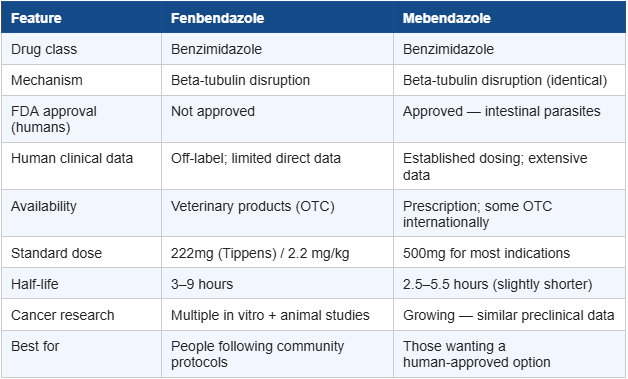
Mebendazole is a realistic choice because it works the same way, is in the same drug family, has been tested on real people, and is FDA-approved for certain uses. Mebendazole is the clear winner if you want a benzimidazole that is the safest for people.
The practical justification for fenbendazole is that most community protocols refer to it, the research most closely related to the Tippens story utilizes it instead of mebendazole, and it is available over the counter as a veterinary medicine. For those who are following the recognized methods for treating parasites and cancer, this is the chemical that most of the community data points to.
11. Panacur and Safe-Guard: The Veterinary Sources Most People Use
Most people who take fenbendazole utilize veterinary medications because they are not approved for people. Panacur C (canine granules) and Safe-Guard (which comes in several forms) are the two most spoken about.
Panacur C Canine Granules
Each tiny packet of Panacur C has 222mg of fenbendazole in granular form. The 222mg dosage is what made this medication the standard in human protocols: one sachet is equal to one Tippens dose. It’s easy to measure, you can find it almost anywhere, and the concentration is plainly marked.
Microcrystalline cellulose and povidone are two of the inactive ingredients in Panacur C that are generally thought to be safe for people. The granular format can be added to food, which assists with the need to absorb fat.
Safe-Guard Granules
There is 100mg of fenbendazole in every gram of Safe-Guard 10% granules. They function in the same manner, but they need a little more arithmetic. A 2.22-gram scoop is the same as a 222mg Tippens dose. You may find it in agricultural supply stores and online.
What to Look For When Sourcing
- Clear concentration labeling: You need to know exactly how many milligrams are in each packet or scoop.
- Only one active ingredient: fenbendazole. This is not a combo product.
- Intervet (Merck Animal Health) makes Panacur, while Merck makes Safe-Guard.
- If you acquire fenbendazole in human pill form from a supplement manufacturer, ask for a Certificate of Analysis. Purity standards in that area are very different.
12. Side Effects and Safety: What to Actually Expect
Fenbendazole is safe to use at the levels utilized in human studies. This isn’t marketing rhetoric; it’s based on the drug’s lengthy history of usage in animals and the evidence that has been collected about its use in people for other purposes.
Common and Generally Mild
- Nausea or moderate stomach upset: the most prevalent. This is often because of the granule format and not the medicine itself. Mixing it with meals makes this far less of a problem.
- Diarrhea or loose stools: This is most common in the first few days as the body gets rid of the parasites. Most of the time, they stop on their own.
- Mild fatigue: This is something that people may describe in the first week, especially when they take bigger doses or have a Herxheimer-style die-off response.
Liver Enzymes
The liver breaks down both fenbendazole and mebendazole. This isn’t usually a concern at normal short-term doses. Monitoring liver function enzymes (ALT, AST) is sensitive to prolonged protocols, weeks or months of cycle use. There are a few case reports in the literature of long-term fenbendazole users having higher liver enzymes, although most of these problems went away after the dose was lowered or stopped.
If you’re going to be on a treatment for more than a few months, it’s smart to get a baseline liver panel before you start and another one 6 to 8 weeks later.
The Die-Off Response
When a lot of parasites are killed quickly, they emit metabolic byproducts that might induce a transient systemic inflammatory reaction, like fever, rash, itching, and mild joint discomfort. This is the Jarisch-Herxheimer reaction, which has been seen with many antiparasitic therapies. It looks bad, but it usually goes away in 48 to 72 hours. It’s not a sign of toxicity; it’s a sign that the drug is functioning.
13. Who Should Be Especially Careful
- Children: No established pediatric dosing exists for fenbendazole specifically. Mebendazole has pediatric dosing data — the safer choice in that population.
- Anyone on polypharmacy: The older your medication list, the more important it is to run this by a pharmacist or physician before starting. Benzimidazoles have a moderate interaction potential that grows with each additional drug.
- People with pre-existing liver disease: Fenbendazole is processed by the liver in people who already have liver disease. Drug exposure and the chance of elevated enzymes are both increased by impaired liver function.
- Anyone taking warfarin or other anticoagulants: They should be aware that benzimidazoles may change the metabolism of warfarin by influencing the activity of the CYP450 enzyme. It is necessary to check INR.
- Pregnant women: Research on animals indicates that large dosages of fenbendazole may be teratogenic. Human pregnancy safety information is lacking. Avoid during pregnancy, especially in the first trimester when organogenesis is taking place.
14. Where to Buy Fenbendazole for Humans
Veterinary Sources (Most Common)
Safe-Guard granules and Panacur C canine granules (222 mg sachets) can be purchased from major online sellers as well as farm supply stores like Tractor Supply and Rural King. These are genuine, obviously concentrated goods. Although they are made for dogs, the inactive ingredients are usually suitable for human consumption, the active substance is the same, and the concentration is labeled.
Specialty Human-Formulation Suppliers
Nowadays, a rising number of supplement manufacturers sell fenbendazole in human-specific pill form, usually at a dose of 222 mg. There are differences in quality. Request a Certificate of Analysis from independent testing before placing an order from any of these vendors. This document verifies that the fenbendazole in the product is pure and free of impurities.
Mebendazole
Mebendazole is offered through authorized pharmacies if you’re looking for a human-approved benzimidazole with a proven clinical track record. Mebentel 500 (Mebendazole 500mg), pharmaceutical-grade pills made in accordance with human-use guidelines, are available on RxFarmacia.com. With FDA approval, this is the medicine for anyone who desires the same mechanism as fenbendazole.
View Mebentel 500mg (Mebendazole) at RxFarmacia.com →
Albendazole
Albendazole has a broader spectrum than fenbendazole for those seeking more comprehensive antiparasitic coverage, including tapeworms and tissue-invasive parasites. For individuals considering that option, Albendazole 400mg is available on RxFarmacia.com.
View Albendazole 400mg at RxFarmacia.com →
Combination Products
RxFarmacia.com offers Bandy Plus (Ivermectin & Albendazole) as a handy single-tablet solution for those interested in the synergistic antiparasitic combination of ivermectin and albendazole, which covers a larger spectrum than either treatment alone.
View Bandy Plus (Ivermectin & Albendazole) at RxFarmacia.com →
15. Frequently Asked Questions
What is the recommended fenbendazole dosage for humans?
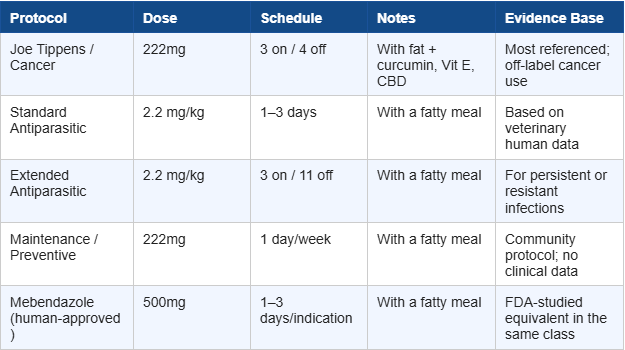
The FDA has not approved a dosage for humans. The Joe Tippens protocol, which calls for 222 mg three days a week (on-off-on-off-on-off-off), is the dosage that is most frequently cited. Practitioners also utilize weight-based estimation, which is 2.2 mg/kg body weight and corresponds with mebendazole dosage in the same drug class. Every human usage is off-label, and a healthcare professional should be involved.
How much fenbendazole should I take per day?
Based on the Joe Tippens protocol and the handy size of Panacur C sachets, the majority of human protocols employ 222 mg on dosing days. For bigger people, certain weight-based methods recommend somewhat higher dosages. Most protocols don’t require daily continuous dosage because of the drug’s short half-life (3–9 hours); the most popular schedule is three days on, four days off.
Can you take fenbendazole every day?
You can, however, most guidelines advise against doing so for prolonged periods of time. The medicine has a short half-life and doesn’t require a daily dose to maintain action, and the off days lessen the cumulative hepatic burden for long-term treatments, which is why the cycling plan is in place. Acute antiparasitic treatment is administered in short, continuous courses lasting three to five days. There is no defined regimen that calls for long-term daily use without cycling.
Does fenbendazole need to be taken with food?
Yes, and this is essential rather than discretionary. On an empty stomach, fenbendazole absorbs slowly since it is fat-soluble. Research indicates that when consumed with a fatty meal, bioavailability improves three to four times. A tablespoon of full-fat yogurt, peanut butter, or any modest meal with 15–20 grams of fat will do. The amount that enters your bloodstream is greatly decreased when you take it without eating.
Is fenbendazole safe for humans?
Based on veterinary history and known off-label human use data, fenbendazole has a generally good safety profile at the levels used in human procedures (around 222 mg). Mild gastrointestinal problems are typical side effects. Liver enzyme increase is the primary monitoring factor for prolonged usage; for multi-month treatments, a baseline and monthly liver panel is recommended. During pregnancy, it is not safe.
What is the difference between fenbendazole and mebendazole?
They have comparable safety profiles, function via the same mechanism (beta-tubulin disruption), and are members of the same pharmacological class (benzimidazoles). The main distinction is that fenbendazole is not FDA-approved for human usage, but mebendazole is at doses up to 500 mg. Both have preclinical studies about cancer. For those seeking verified human clinical evidence, mebendazole is the better-documented option.
Where can I buy fenbendazole for humans?
Fenbendazole is available at Rx Farmacia with a very wide range of options, which are (150mg, 222mg, 444mg, 500mg, 1000mg), and you can order them at your doorstep at an affordable rate with worldwide delivery.
Click here to explore Fenbendazole for Humans →
What is the Joe Tippens fenbendazole protocol?
After self-administering fenbendazole (222 mg, three days per week) coupled with curcumin, vitamin E succinate, and CBD oil, Joe Tippens, a patient with terminal cancer, experienced an unexpected recovery. In 2019, his story went viral and generated a lot of curiosity from researchers. Since he was also taking part in an immunotherapy trial at the time, it is technically impossible to determine if fenbendazole caused his remission. When it comes to fenbendazole use in issues related to cancer, his regimen has become the de facto standard.
Can fenbendazole treat cancer?
In cell culture and animal experiments, fenbendazole has shown anticancer capabilities by interfering with the uptake of glucose by cancer cells, causing apoptosis, and interrupting tumor cell division. These are actual results from reputable studies. A comprehensive human randomized controlled study demonstrating a survival benefit does not yet exist. Fenbendazole is not recognized as a validated cancer treatment by any major oncology group. Preclinical science shows great promise. There is currently no clinical evidence.
16. The Bottom Line
The dosage of fenbendazole for humans is in a truly intriguing and uncertain area. No dosage is authorized. There isn’t a package insert made specifically for you. What exists is a significant body of preclinical research, a community-developed protocol that has been utilized by thousands of individuals, a class of drugs that have a near human-approved relative, and a set of pharmacological principles that support some dosages more than others.
For most adults, the 222 mg, three-days-on, four-days-off regimen is a fair starting point. It should be taken with a fatty meal, monitored with regular liver function tests throughout prolonged use, and ideally discussed with a doctor who can take into account your complete health picture and drug list.
Mebendazole is the more environmentally friendly option if you want the same mechanism with a proven human track record. Albendazole and combination medicines greatly increase the antiparasitic coverage when used in conjunction with fenbendazole or mebendazole.
If you’re looking forward to getting Fenbendazole tablets for humans, then we’ve got you covered. We offer a wide range of products on our website.
Medical Disclaimer
This article is for informational and educational purposes only, and doses do not constitute any medical advice, diagnosis, or treatment. Fenbendazole is not FDA-approved for human use. All references to human dosing are off-label and based on community protocols and analogous drug class data. Always consult a qualified healthcare provider before starting, stopping, or modifying any medication or health protocol. References to cancer-related research do not constitute a treatment recommendation.
