Mebendazole for Adults: Uses, Dosage, and What US Buyers Need to Know in 2026
Most people who get around to investigating mebendazole fall into one of two camps. The first group has a parasitic infection, and they want to know what they have been prescribed. The second group is already exploring fenbendazole or ivermectin and has found mebendazole as the human-approved option in the same drug class.
“This guide covers both. What mebendazole really is, how it works, what it treats, how to dose it correctly, and how it stacks up against fenbendazole for anyone trying to make sense of the benzimidazole landscape.
What Is Mebendazole?
It’s a benzimidazole anthelmintic that kills intestinal worms by blocking the protein beta-tubulin, which is required for the survival of parasites. It was approved by the FDA in 1974 and has been in continuous clinical use for almost 50 years, and is therefore one of the most extensively investigated antiparasitic drugs available.
In the United States, it is sold under the brand names Emverm (100mg chewable pills) and Vermox (100mg chewable tablets), and is also available in a 500mg generic formulation. In the United States, it is a prescription medicine; in many other countries, it is available over the counter.
One interesting feature that often surprises people researching this class of drugs is that fenbendazole and mebendazole are pretty much chemical cousins. Both chemicals are benzimidazoles. They both work the same way. The main difference is the regulation. Mebendazole is permitted for human use by the FDA, but fenbendazole is only approved for veterinary use. This distinction is important for access, safety data, and the cancer research environment.
How Mebendazole Works: The Mechanism
Understanding the process explains both the effectiveness of mebendazole and its attractiveness in cancer research.
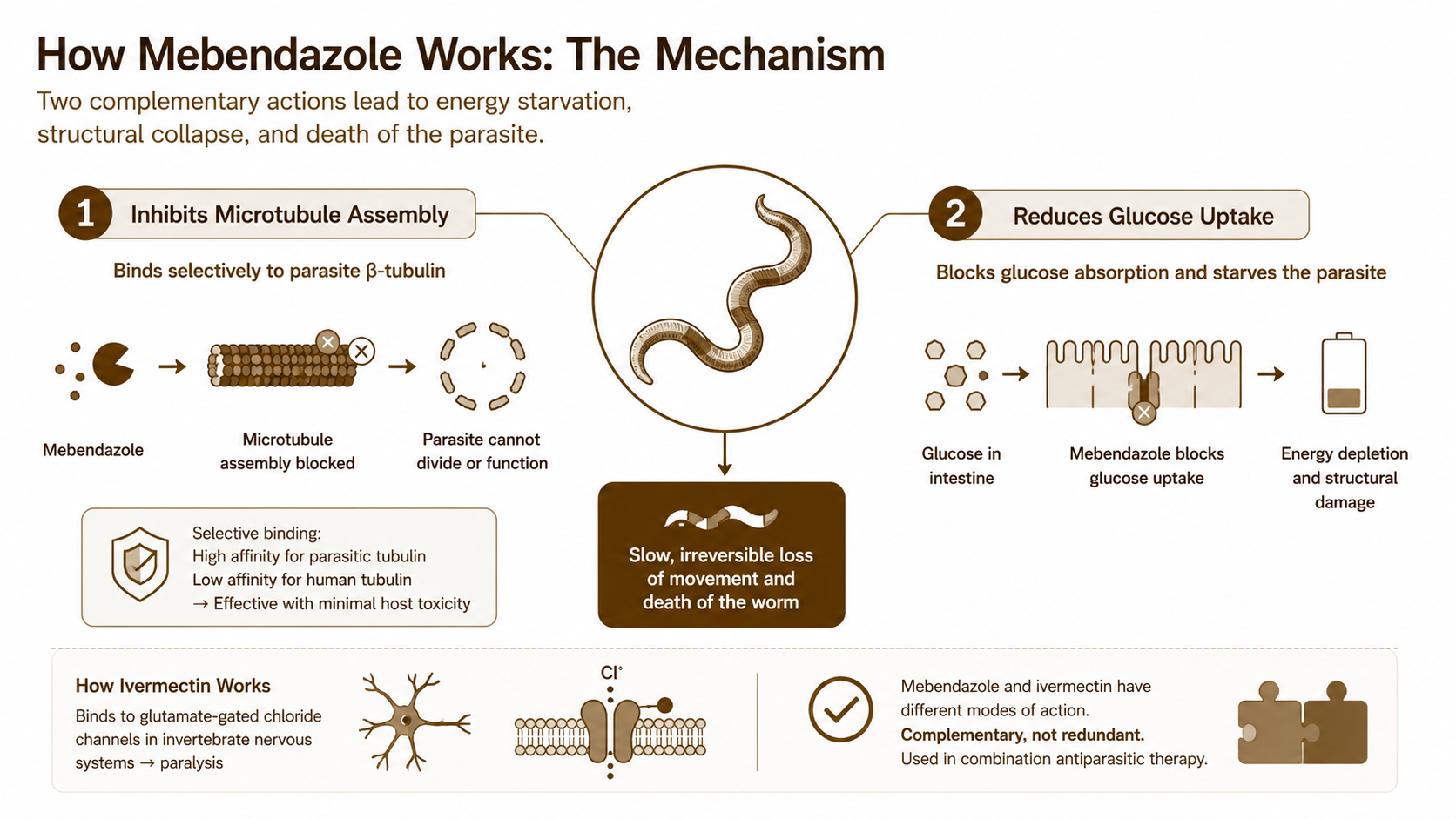
It works on the parasite cell by two complementary methods.
First, it binds only to beta tubulin in cells of parasites and inhibits the assembly of the microtubules. Microtubules are the intracellular scaffolding that cells use to divide, to maintain structure, and to transport materials. If the microtubules are not working, the parasite can’t divide or move things around inside its cells, and it dies. The binding is selective: at therapeutic concentrations, mebendazole has a much higher affinity for parasitic tubulin than for human tubulin. This explains its effectiveness against parasites with little damage to the human host.
It decreases glucose uptake in susceptible parasites. Intestinal helminths depend upon the absorption of glucose from the intestinal environment for energy. Mebendazole blocks this absorption and starves the parasite, effectively cutting it off from its main energy source, and damages its structure. The interaction of these two systems leads to a slow, irreversible loss of movement and death of the worm, rather than a sudden paralysis.
That’s different from ivermectin which has a different mode of action. It binds to glutamate-gated chloride channels in invertebrate nervous systems, causing paralysis. The two drugs are complementary and not redundant and are therefore used in combination antiparasitic therapy.
What Mebendazole Treats: FDA-Approved Indications
The FDA-approved indications for mebendazole cover the four most common intestinal helminth infections encountered in clinical practice in the United States and globally.
A second dose two weeks after the first is recommended for pinworm infections, because it kills only adult worms and does not kill pinworm eggs. Reinfection may occur from eggs shed previously into the environment after 2 to 6 weeks. The second dose kills recently hatched worms before they have a chance to reproduce.
Because of the great efficiency of person-to-person transmission via hand contamination of surfaces, it is critical to treat all members of the household simultaneously for pinworm. If one person is treated and the rest of the household is not treated, that person will almost always be reinfected in a short time.
Mebendazole Dosage for Adults: The Complete Guide
It is easier to dose than most antiparasitic drugs, because at average dosages it is not dependent on body weight. Standardized adult doses for the four principal indications are approved regardless of body weight.
It is poorly absorbed from the gastrointestinal tract at normal doses. Less than 2 % of an oral dose reaches the systemic circulation. This is useful in treating intestinal worms: the medicine stays in the gastrointestinal tract, where the parasites live, at high local concentrations, and does not need to be absorbed systemically to be effective.
In some off-label usage in which systemic effects are desired (e.g., some cancer studies), administration of mebendazole with a high-fat meal can greatly increase systemic bioavailability. From the studies, it has been shown that fatty food has a substantial effect on plasma concentrations as compared to fasting treatment. This assumption is similar to the dietary requirement for fenbendazole due to similar pharmacokinetic considerations.
Mebendazole vs Fenbendazole: The Comparison Everyone Is Looking For
Our question attracts many people to our site and deserves a thorough, honest answer.
Mebendazole and fenbendazole belong to the benzimidazole group of anti-parasite medicines. They have the same basic chemical structure, the same basic method for binding to beta-tubulin, and similar secondary effects on glucose metabolism. They are pharmacologically related drugs. The real differences between them are fairly large.
The bottom line is that if the purpose is to treat a confirmed intestinal parasite infection, mebendazole is the right clinical choice, because it is FDA-approved for human usage and has a 50-year safety record. Of the examination of cancer procedure of benzimidazoles, mebendazole has more completed data of human trials, but neither has efficacy been proven in people in cancer treatment.
For the complete fenbendazole guide, including the cancer research evidence table, see what is fenbendazole at rxfarmacia.com.
Mebendazole and Cancer Research: The Human Data Advantage
This part is important as it clarifies the difference between mebendazole and fenbendazole, which is often missed in online debates.
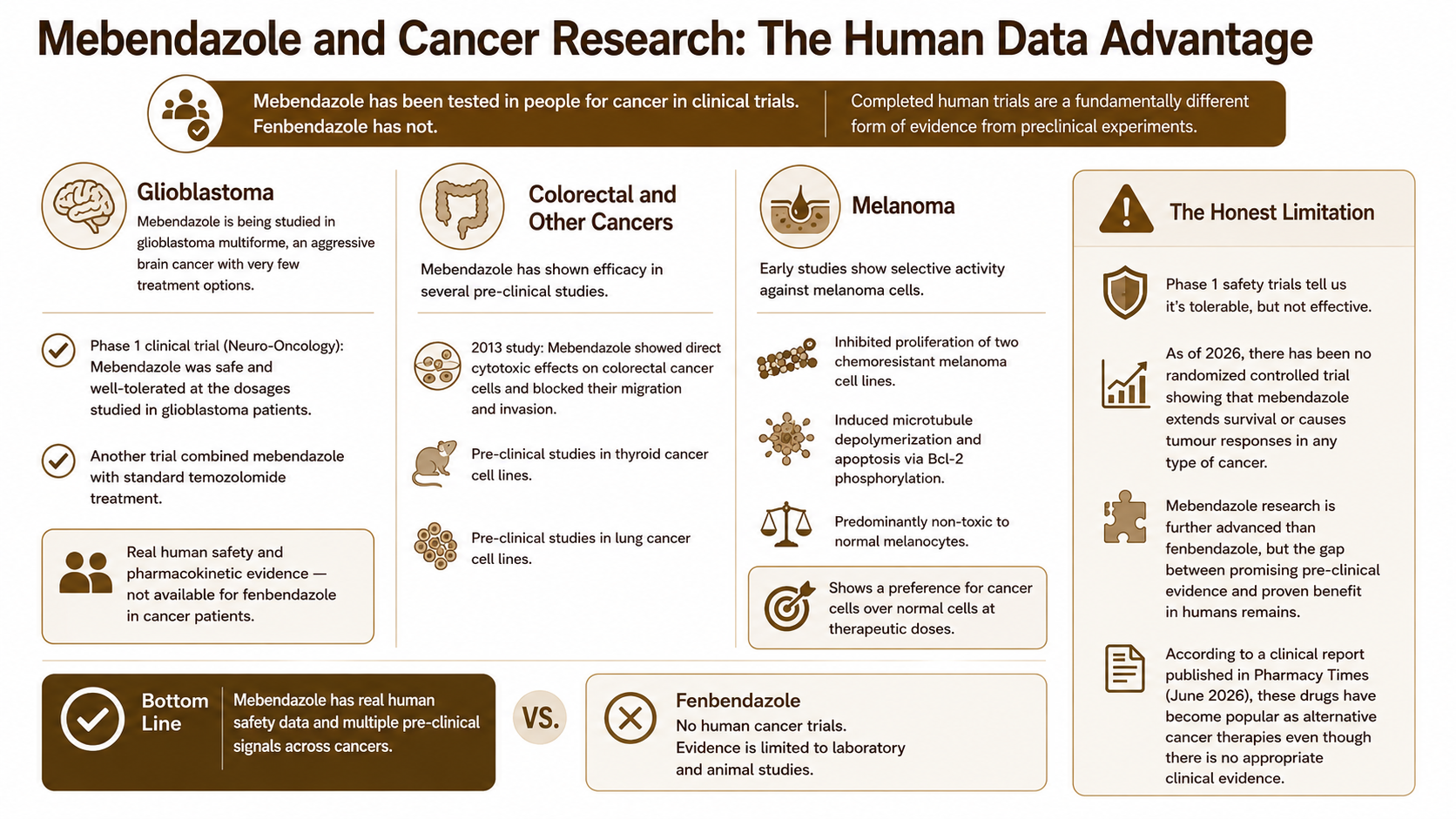
Fenbendazole has not been tested in people for cancer in clinical trials, but mebendazole has been. And that is a big difference. Completed human trials are a fundamentally different form of evidence from preclinical cellular and animal experiments.
Glioblastoma
It’s being studied in glioblastoma multiforme, an aggressive brain cancer with very few treatment options. Mebendazole was safe and well-tolerated at the dosages studied in glioblastoma patients in a Phase 1 clinical trial published in Neuro-Oncology. Another trial studied mebendazole in combination with standard temozolomide treatment. They are not cure claims, but actual human safety and pharmacokinetic evidence that fenbendazole does not have in cancer patients.
Colorectal and Other Cancers
It has shown efficacy in several pre-clinical studies on colorectal cancer cell lines and mice. In a 2013 study, mebendazole was found to not only have direct deadly effects on colorectal cancer cells but also to block their migration and invasion. Studies with thyroid cancer and lung cancer cell lines have also been described.
Melanoma
One of the earliest studies investigating in cancer research demonstrated that although mebendazole was predominantly non-toxic to normal melanocytes, it inhibited the proliferation of two chemoresistant melanoma cell lines by inducing microtubule depolymerization and apoptosis via Bcl-2 phosphorylation. Mebendazole shows a preference for cancer cells over normal cells at therapeutic doses and is hence an attractive candidate for repurposing.
The Honest Limitation
Phase 1 safety trials tell us that it’s tolerable, but not effective. As of 2026, there has been no randomized controlled investigation demonstrating that mebendazole extends survival or causes tumour responses in any type of cancer. The study into mebendazole is further advanced than that into fenbendazole, but, too, the gap in data from promising pre-clinical and animal studies to shown benefit in humans remains unfilled. According to a clinical report published in Pharmacy Times in June 2026, these drugs have become popular as alternative cancer therapies even though there is no appropriate clinical evidence.
Side Effects: What to Expect
At standard doses for intestinal infections, mebendazole is well tolerated. The poor systemic absorption means most people experience minimal side effects.
Other Drug Interactions and Contraindications
- Cimetidine: Inhibits the liver enzyme that metabolizes mebendazole, increasing plasma levels. Clinically significant mainly with high-dose or prolonged mebendazole use.
- Carbamazepine and phenytoin: Both reduce mebendazole plasma levels by inducing liver enzymes. May reduce efficacy for indications requiring systemic levels (echinococcal disease, off-label use).
- Biliary obstruction: Mebendazole is primarily excreted through bile. In patients with biliary obstruction, use with caution as drug elimination may be impaired.
- Liver disease: Use with caution in significant hepatic impairment; standard short-course treatment is generally considered acceptable, but prolonged high-dose protocols require careful monitoring.
Pregnancy and Breastfeeding Mebendazole for adults
Mebendazole is classified as Pregnancy Category C. Animal studies have shown embryotoxic and teratogenic effects at doses similar to therapeutic ones in humans. Use in the first trimester is absolutely contraindicated.
Among a postmarketing review of 170 deliveries among women who inadvertently swallowed mebendazole during the first trimester, the rates of spontaneous miscarriage and deformity were not higher than those found in the general population. This is somewhat reassuring, but does not change the usual advice that mebendazole should not be used in pregnancy.
A risk-benefit discussion with a healthcare practitioner is important for pregnant women with symptomatic parasite infections. Many parasitic infections offer more of a risk to pregnancy than the potential hazards of therapy, but this is a clinical judgment decided on an individual basis.
Mebendazole is probably excreted in small amounts in breast milk. The safety of nursing infants is not established; nevertheless, short treatment regimens at conventional dosages are generally considered to be low risk, but consultation with your healthcare professional is recommended.
Is Mebendazole Available Over the Counter?
Mebendazole is a prescription medicine in the U.S. In the US, it is not available over-the-counter in retail pharmacies; it is available without prescription in several countries, including the UK, Canada, Australia, and much of Europe.
This creates an access gap that has driven many US patients to procure mebendazole from international pharmacy providers. You can get pharmaceutical-grade mebendazole 500mg pills from trusted international suppliers such as rxfarmacia.com, which produce them to pharmaceutical-grade standards, with clearly labelled batch numbers and expiry dates.
View Mebencure 500mg (Mebendazole 500mg Tablets) at RxFarmacia.com →
View MendiTaj 500mg (Mebendazole 500mg Tablets) at RxFarmacia.com →
View Mebex 100mg (Mebendazole 100mg Tablets) at RxFarmacia.com →
Mebendazole in the Antiparasitic Stack
If you are using mebendazole as part of a full antiparasitic protocol that includes ivermectin or fenbendazole, it is important to understand the interaction and synergy of the three drugs.
It is not a routine practice to provide mebendazole and fenbendazole at the same time. They share the same beta-tubulin mechanism and the same metabolic pathway via CYP3A4. There is no added benefit from co-administration, as they compete for the same receptor targets and concurrent CYP3A4 inhibition increases hepatic load without any comparable advantage.
Mebendazole and ivermectin have different modes of action and can be used in combination therapy as they target different physiological pathways. Ivermectin operates as a modulator of chloride channels in the nervous system of invertebrates. Mebendazole acts as an inhibitor of tubulin assembly and glucose uptake. Complementary rather than redundant.
For the complete guide to combining ivermectin and fenbendazole, including timing and binder protocols, see Ivermectin and Fenbendazole together at RxFarmacia.com.
Frequently Asked Questions
Is mebendazole the same as fenbendazole?
They belong to the same pharmacological class (benzimidazoles) and have a similar mode of action via binding to beta-tubulin. The differences are considerable. It is licensed by the FDA for human use, with 50 years of clinical data supporting it. Fenbendazole is only approved for veterinary use. It has been tested in human clinical trials for oncological use with positive results, whereas fenbendazole has not. They are chemically similar, but not identical compounds
Is mebendazole for adults?
It is indicated for use in adults and children over 2 years of age. Adults at standard doses do not require dose adjustment based on weight. A single dose of 500mg is effective against pinworms; roundworms, hookworms, and whipworms are treated with 100mg twice daily for three days.
Does mebendazole require a prescription?
Yes, in the United States. Mebendazole is available in the US via prescription only, but is available over-the-counter in many other countries, such as the UK and Canada. You may find 500mg tablets of pharmaceutical quality from reliable foreign online pharmacy suppliers like rxfarmacia.com.
What is the difference between mebendazole 100mg and 500mg?
The usual dose is one 100mg tablet taken twice a day for three days for illnesses caused by roundworms, hookworms, and whipworms. The 500 mg tablet is given as a single dose for pinworms or, in some protocols, as a single-dose therapy for 3-day indications where a simpler regimen is preferred. Both contain the same active ingredient but in different concentrations.
Can mebendazole be taken with food?
In intestinal infections, It is given in the usual doses with or without food. When used off-label and systemic absorption is desired, taking it with a high-fat meal will significantly increase bioavailability. The chewable tablet versions may be chewed, taken whole, or crushed and mixed with food.
How does mebendazole compare to albendazole?
Both chemicals are benzimidazoles, and the methods are similar. Albendazole is better absorbed than mebendazole and is preferred for use in systemic disease states (e.g., echinococcal cysts, neurocysticercosis, and lymphatic filariasis) in which the medicine needs to be distributed outside of the gastrointestinal tract. Both are FDA-authorized and effective for intestinal infections. Mebendazole has a longer history of approval in the United States than albendazole, which was approved in 1996.
Can you take mebendazole and ivermectin together?
Yes, sequential or combinatorial approaches. They act through different mechanisms and do not compete with each other for receptor sites. Ivermectin acts on the neurological system of invertebrates. Mebendazole decreases glucose absorption and tubulin assembly. Both have this synergistic activity, which is why they are combined in several broad-spectrum antiparasitic medicines. If you take both, it is suggested that your liver be monitored at the same time.
What should I avoid while taking mebendazole?
The major contraindication is the concomitant use of metronidazole, known to carry a documented risk of Stevens-Johnson syndrome. Avoid use in the first trimester of pregnancy. Take care when using cimetidine (which can raise mebendazole levels) and when using carbamazepine or phenytoin (which can lower mebendazole levels). Tell your physician about all of your drugs before you start.
The Bottom Line
The only benzimidazole permitted for human use is mebendazole. It has been in clinical use for more than 50 years and is FDA-approved for four intestinal parasite disorders, and has a well-documented safety profile at typical dosages. Poor gastrointestinal absorption is common for intestinal diseases and should be considered for any off-label use requiring systemic levels.
Mebendazole and fenbendazole have the same fundamental mechanism. Mebendazole has better clinical proof on humans for conventional antiparasitic applications as well as oncological investigations. Mebendazole is the starting point for understanding the benzimidazole class and has been used in humans for fifty years with success for its intended purpose.
Medical Disclaimer: This article is for informational and educational purposes only and does not constitute medical advice. Mebendazole is a prescription medication in the United States. Do not use this information to self-diagnose or self-treat parasitic infections. The cancer research discussed has not established mebendazole as an effective cancer treatment. Consult a licensed healthcare provider before starting any antiparasitic treatment, particularly if you are pregnant, have liver disease, or are taking other medication