
Blog
Fenbendazole Dosage Calculator: How to Calculate Your Dose by Weight (2026)
Jun
The 222mg fixed dose provides a greater relative exposure (mg/kg) for persons with lower body weight and a diminished relative exposure for those with higher body weight. The HED-derived value correlates with body weight and aligns more closely with the 444mg dosage for the majority of adult weights. Neither of these constitutes a recommendation. They serve as a framework for comprehending the significance of each statistic in relation to your individual body weight.
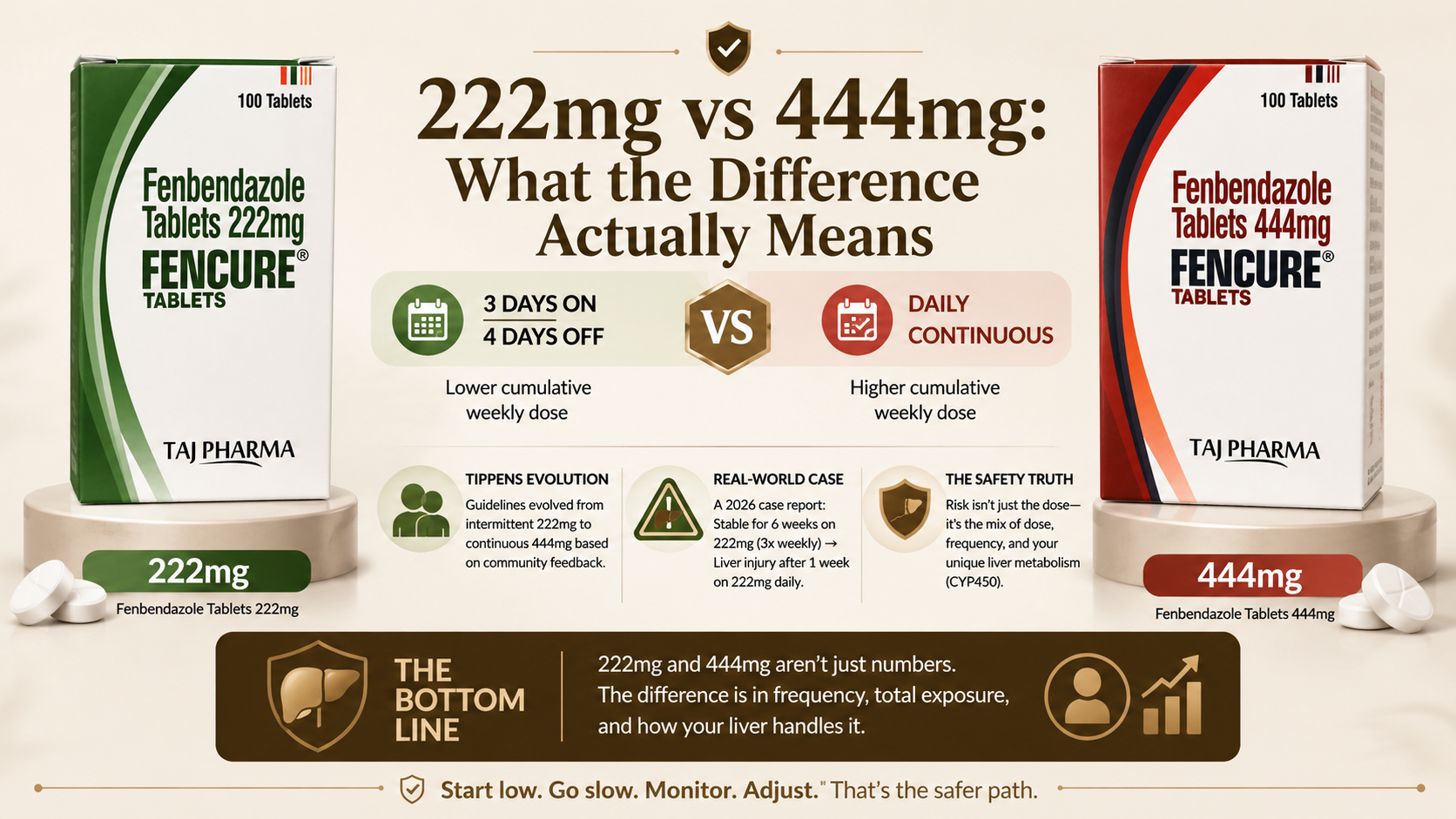
222mg vs 444mg: What the Difference Actually Means
This is a commonly posed inquiry, and the truthful response encompasses both the aforementioned dosing calculations and the safety evidence that has surfaced regarding dose escalation.
The initial Tippens treatment (222mg, 3 days on, 4 days off) resulted in a reduced cumulative weekly dose compared to the revised protocol (444mg daily continuous). Tippens progressively revised his guidelines in response to community input, transitioning towards a larger continuous dosage for certain users.
The 2026 case report published in the World Journal of Clinical Cases is pertinent to this discussion. The case report detailed a patient who was asymptomatic for six weeks while receiving 222 mg three times weekly, subsequently experiencing serious liver impairment within one week of escalating the dosage to 222 mg daily. The critical aspect is not solely the dosage level, but rather the escalation: the transition from intermittent to daily treatment, even at an identical per-dose quantity, was linked to the development of liver injury.
The primary safety lesson that the calculator framework fails to encapsulate in a singular figure is that the interplay between dosage, frequency, and individual hepatic metabolism, dictated by CYP450 enzyme activity, which varies considerably among individuals, significantly influences risk, comparable to the milligram amount itself.
Special Populations: Why the Calculator Numbers Need Adjustment
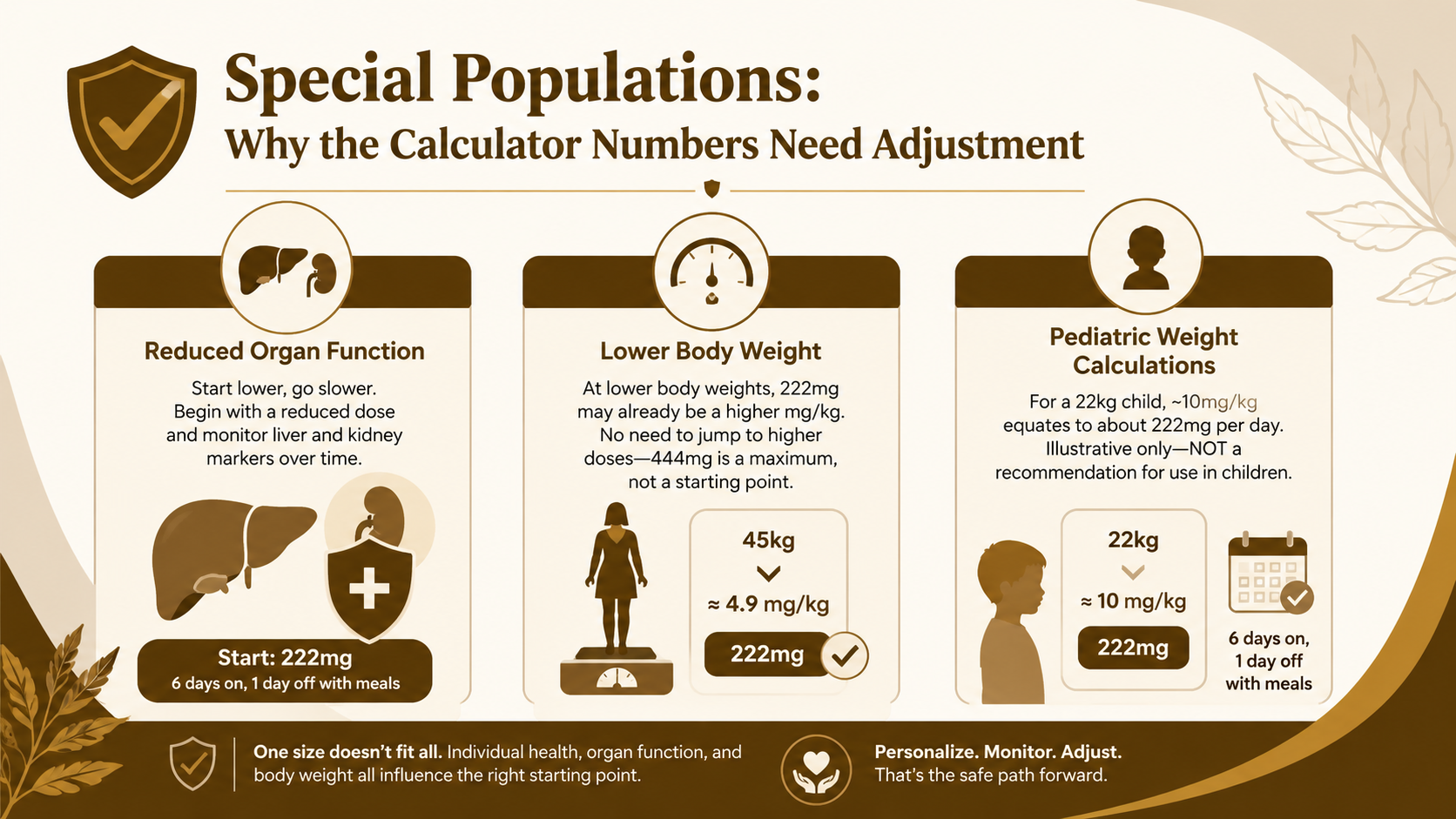
The mg/kg and HED figures above assume a person with normal liver and kidney function. Two scenarios from real clinical discussions illustrate why this assumption matters.
Reduced Organ Function
Even a weight-based dose calculation, such as 444mg for a 108kg person, may be too high as a first dose for a person with cirrhosis and decreased renal function (such as a single working kidney). In these cases, the recommended approach, as per the fenbendazole resource community, is to start with a reduced dose of 222mg with a fatty meal, using a 6-day on, 1-day off regimen, and to only consider increasing the dose if liver enzymes and kidney function markers remain stable over time.
Lower Body Weight
For someone who weighs around 45kg, the mg/kg calculation shows that a daily intake of 222mg is about 4.9mg/kg, which is a bit more than the corresponding dose for a heavier person. If you are on the lower end of the weight scale, it is generally advised to remain on a typical dosage of 222mg, with 444mg being more of a maximum than standard. There is nothing in the current guidelines to warrant jumping straight to the bigger dosages such as 888mg.
Pediatric Weight Calculations
The normal fixed dose at this body weight is around 10mg/kg or 222mg per day for a 22kg person. This is illustrated in several calculator tools with a 6-day-on, 1-day-off schedule with meals. This number is not a recommendation to use fenbendazole in children but is for illustrative purposes only to show how the mg/kg framework relates to body weights, not as an endorsement for paediatric usage of fenbendazole.
The Liver Monitoring Schedule: Non-Negotiable Regardless of Dose
Every framework discussed in this guide converges on one consistent recommendation: regular liver function testing.
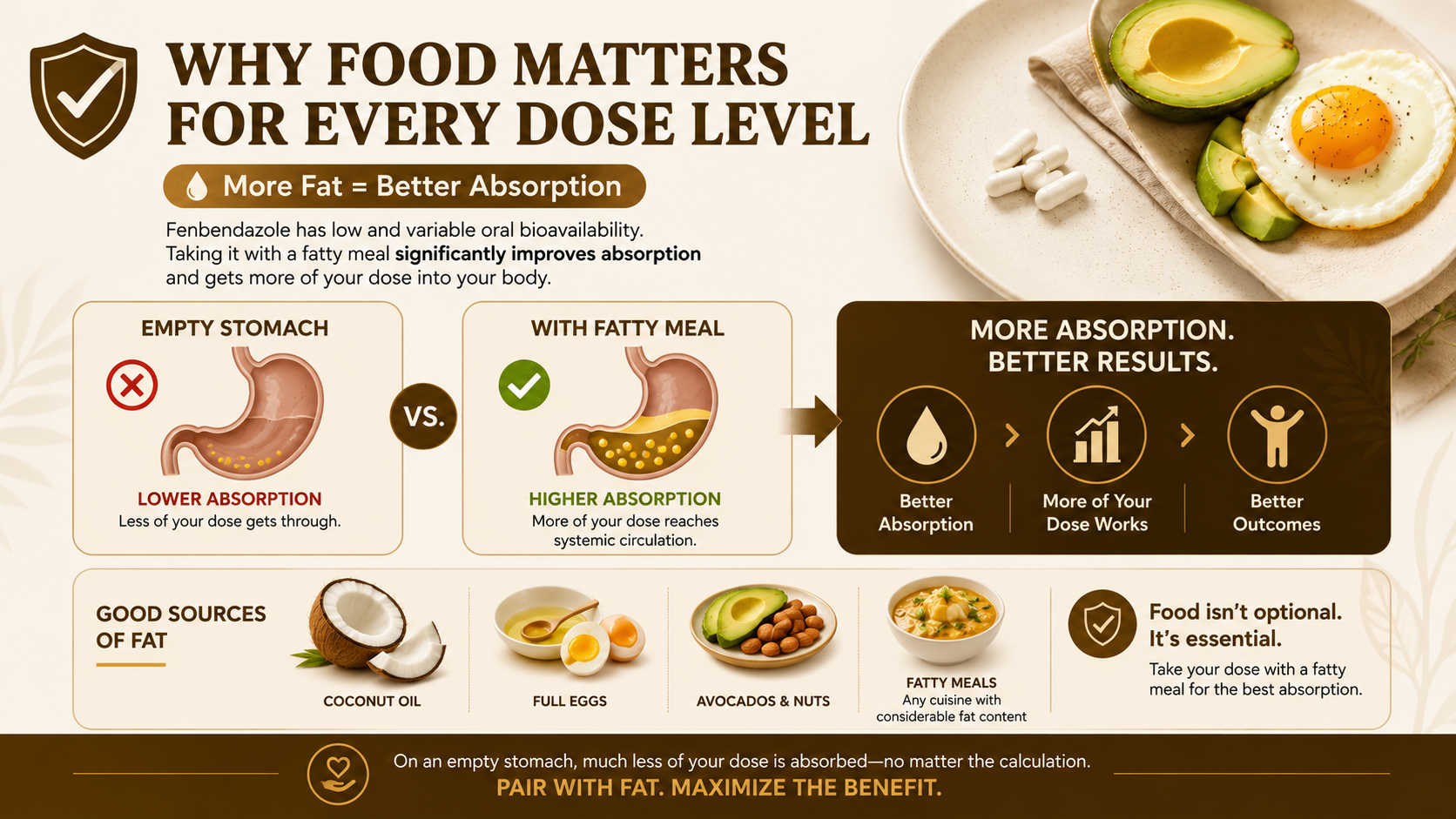
Why Food Matters for Every Dose Level
The absorption concept is the same, no matter the dosing scheme used. Fenbendazole has low and variable oral bioavailability; co-administration with a fatty meal significantly improves the proportion of the dose reaching systemic circulation.
This is stated in nearly every fenbendazole dosing resource, including the EMA tolerance trial protocol, which administered the drug with food. Some practical sources of fat that are commonly suggested are coconut oil, full eggs, or any cuisine with considerable fat content. The dose absorbed, following oral administration of fenbendazole on an empty stomach, is predicted to be much lower than the projected estimate, independent of the method used to develop that estimate.
Sourcing Pharmaceutical-Grade Fenbendazole for Precise Dosing
Regardless of the framework you are using to determine a target dose, the delivered dose will be accurate, depending on the product format. Panacur C granule packets need to be measured out of a 1g or 2g packet, they may vary. Fixed strength tablets (222 mg, 444 mg, 1000 mg) in pharmaceutical grade formulations offer accurate dosing without measurement, which is important since the calculations show how much the mg/kg exposure changes with small changes in absolute dose.
View Fencure 222mg (Fenbendazole 222mg Tablets) at RxFarmacia.com →
View Fencure 444mg (Fenbendazole 444mg Tablets) at RxFarmacia.com →
View Wormentel 1000mg (Fenbendazole 1000mg Tablets) at RxFarmacia.com →
For the complete buyer’s guide covering every sourcing option and how to verify product quality, see Where to buy fenbendazole at RxFarmacia.com.
For the full weight-based dosing protocol guide with binder recommendations, see Fenbendazole dosage for humans at RxFarmacia.com.
Frequently Asked Questions
How do I calculate my fenbendazole dose by weight?
There are two common weight-based approaches. The first calculation is to take your body weight in kilograms and multiply by 10 for a probable daily dose (e.g., a 70kg person would get 700mg which is usually seen as an upper reference rather than a starting point). A second approach employs human equivalent dose scaling from animal studies. This approach gives a daily dose of 284 mg for a 70 kg person using the commonly cited value of 4.05 mg/kg, which is quite near to the fixed protocols of 222 mg to 444 mg.
What is the difference between 222mg and 444mg of fenbendazole?
222 mg is the same as a 1 g Panacur C packet (22.2% concentration) and is the starting dose of the Joe Tippens treatment, given for 3 days, then off 4 days. 444 mg represents a 2 g packet and is a double dosage used in the new continuous regimen followed by some people. The mg/kg exposure for each is very dependent on body weight, as evidenced in the comparison table in this article.
Is there an FDA-approved fenbendazole dosage calculator?
Fenbendazole is not approved for human use by the FDA and so there is no FDA-approved dose calculator for humans. The calculators available, including the one included in this guide, are educational tools and are not approved clinical dosing guidelines; they are based on published research, theoretical extrapolation, and documented human tolerance data.
What is a human equivalent dose and why does it matter?
A human equivalent dose ( HED ) is a way of converting an animal research dose to an anticipated human dose based on body surface area scaling instead of only weight ratios. This is how the FDA calculates the first dose in humans in pharmaceutical development. These are similar to the 222mg and 444mg dosages. So we can provide some scientific background on how these numbers became the normal reference doses. If we scale down the doses of fenbendazole often used in animals using HED (human equivalent dose) scaling, we get the following doses.
How often should I get liver function tests on fenbendazole?
Liver function tests (ALT, AST, bilirubin) are recommended every 2 to 4 weeks routinely, with additional testing within 1 week of any dose escalation, as per clinical case reports and dosage guidelines. A case report in 2026 described severe hepatic injury occurring within one week of changing the dose from intermittent to daily dosing, emphasising the significance of monitoring during dose changes.
Why does the calculator show different numbers for the same body weight?
There is no set formula for the dosage of fenbendazole in humans. The calculator shows three different frames at the same time: established protocol doses, a theoretical 10mg/kg value, and an HED-derived figure. Each of these is a different type of proof. They are not intended to be clinical recommendations. All three are meant to help contextualise a conversation with a healthcare practitioner, not replace it.
Should I start at the highest dose the calculator shows?
No. All sources referenced in this recommendation, including case reports of liver injury, suggest starting treatment at the lower dose (222mg) and monitoring liver function before considering any escalation. The case of liver injury reported occurred after a dose increase, not at the starting dose. The general pattern for all the human data that is available is to start low and watch.
The Bottom Line
When it comes to human dosing of fenbendazole, there are three separate numerical frameworks that are often confused with each other. These are the fixed protocol doses of 222mg and 444mg as depicted on product packaging, a theoretical weight-based dose of about 10mg/kg, and human equivalent dose calculations extrapolated from animal studies using body surface area scaling. The calculator in this guide shows the correlation to your own body weight.
Neither of these statistics can substitute for the two most important elements in practice: beginning treatment at the lower end of any spectrum and carefully monitoring liver function, especially during any changes in dosage. The only case of documented severe liver damage in 2026 was precisely during the time of the dose escalation, the most convincing clue in the available data pointing to the site of the real danger.
