
Blog
How Long Does Doxycycline Stay in Your System? Half-Life, Full Clearance, and Every Wait-Time Answered
Jun
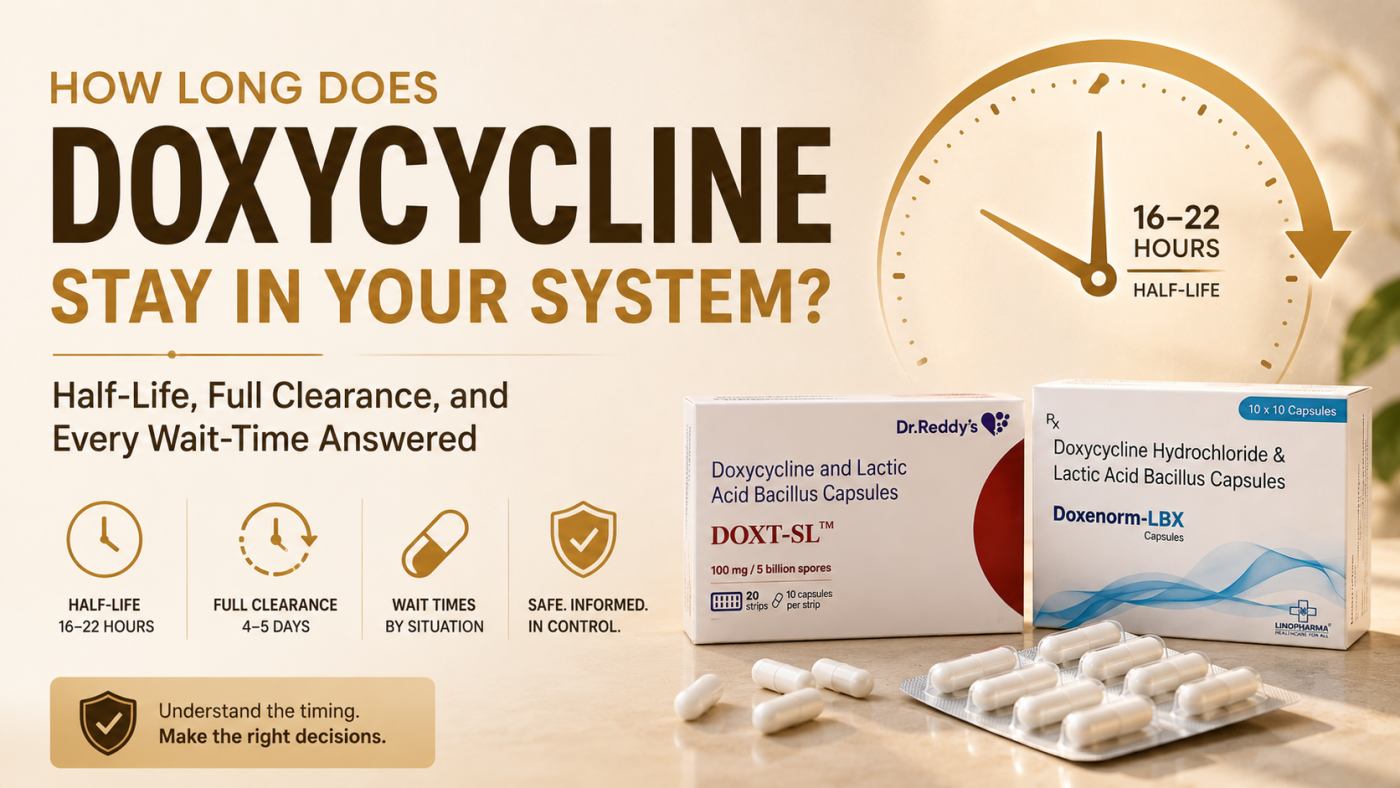
People who ask about how long doxycycline stays in their system are usually looking for a more specific answer: when they can get back to doing a certain thing. The half-life is the first reference but the time for clearing alcohol is different than the time for clearing pregnancy, which is different than the time for clearing photosensitivity which is different than the time for the drug to start working. This guide covers them all, explaining the rationale behind each number.
The Half-Life: What It Is and What It Means
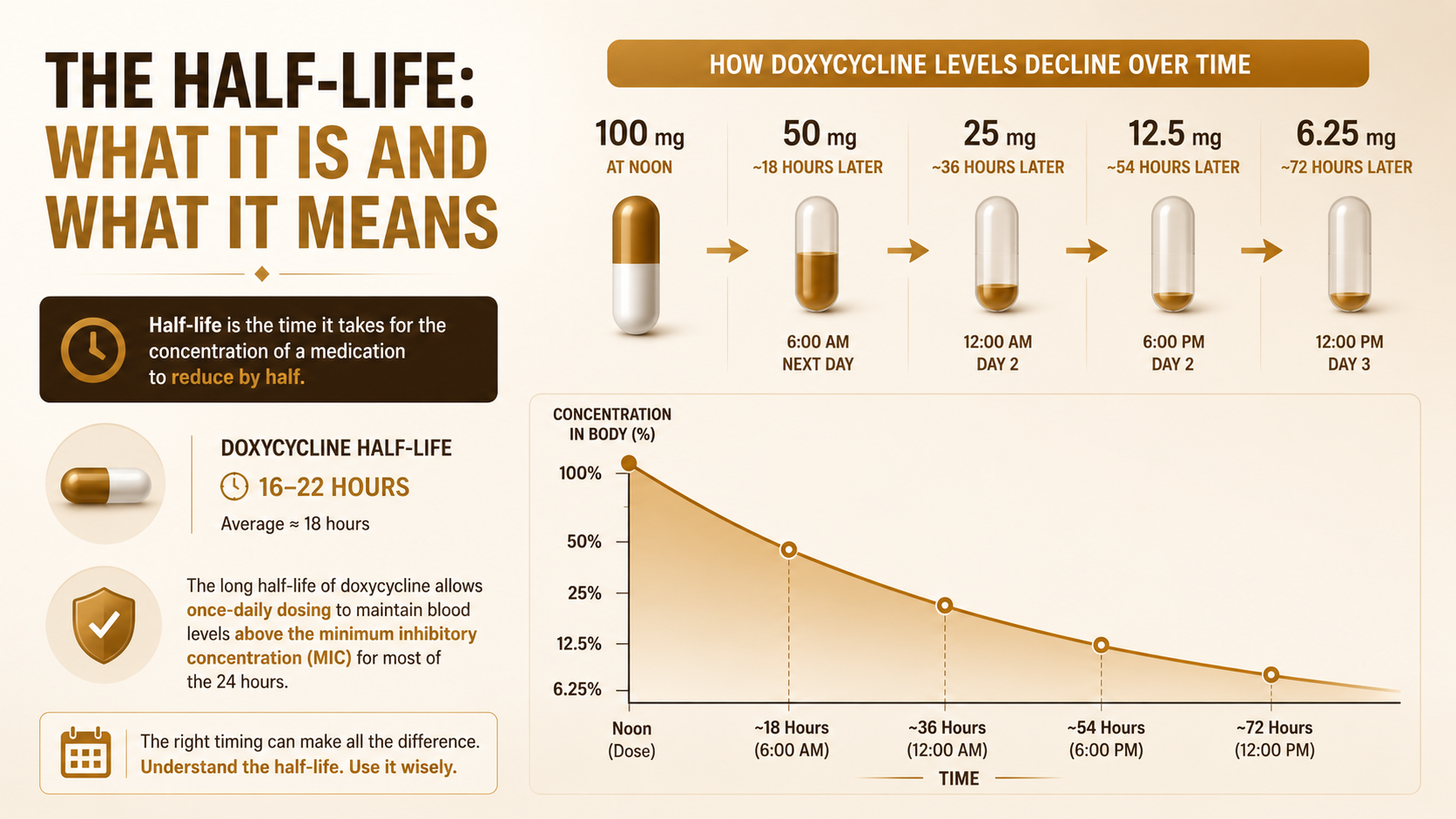
Half-life is the amount of time it takes for the concentration of a medication to reduce by half. In the healthy adult, the half-life of doxycycline is 16-22 hours. The mean quoted by clinical sources is about 18 hours.
This translates to a 100mg dose taken at midday, having about 50mg left in the body at 6 AM the next day, 25mg left at midnight two days later, and so on. After each half-life has gone by, the amount left is one-half of what it was before.
The reason the once-daily dosing of doxy is so effective is that it has a quite long half-life. To maintain therapeutic levels, an antibiotic that is cleared from the body in 4 to 6 hours would have to be given four times a day. The 18-hour half-life of doxycycline enables once-daily treatment to maintain blood concentrations above the minimum inhibitory concentration required to suppress bacterial growth for most of the 24 hours.
How Long Until Doxycycline Is Fully Out of Your System
The pharmacological standard for full drug clearance is five to five and a half half-lives, at which point approximately 97% of the drug has been eliminated.
How Long Does Doxycycline Take to Start Working?
This question is different from clearance, although asked in the same search context. It is helpful to know both ends of the time span.
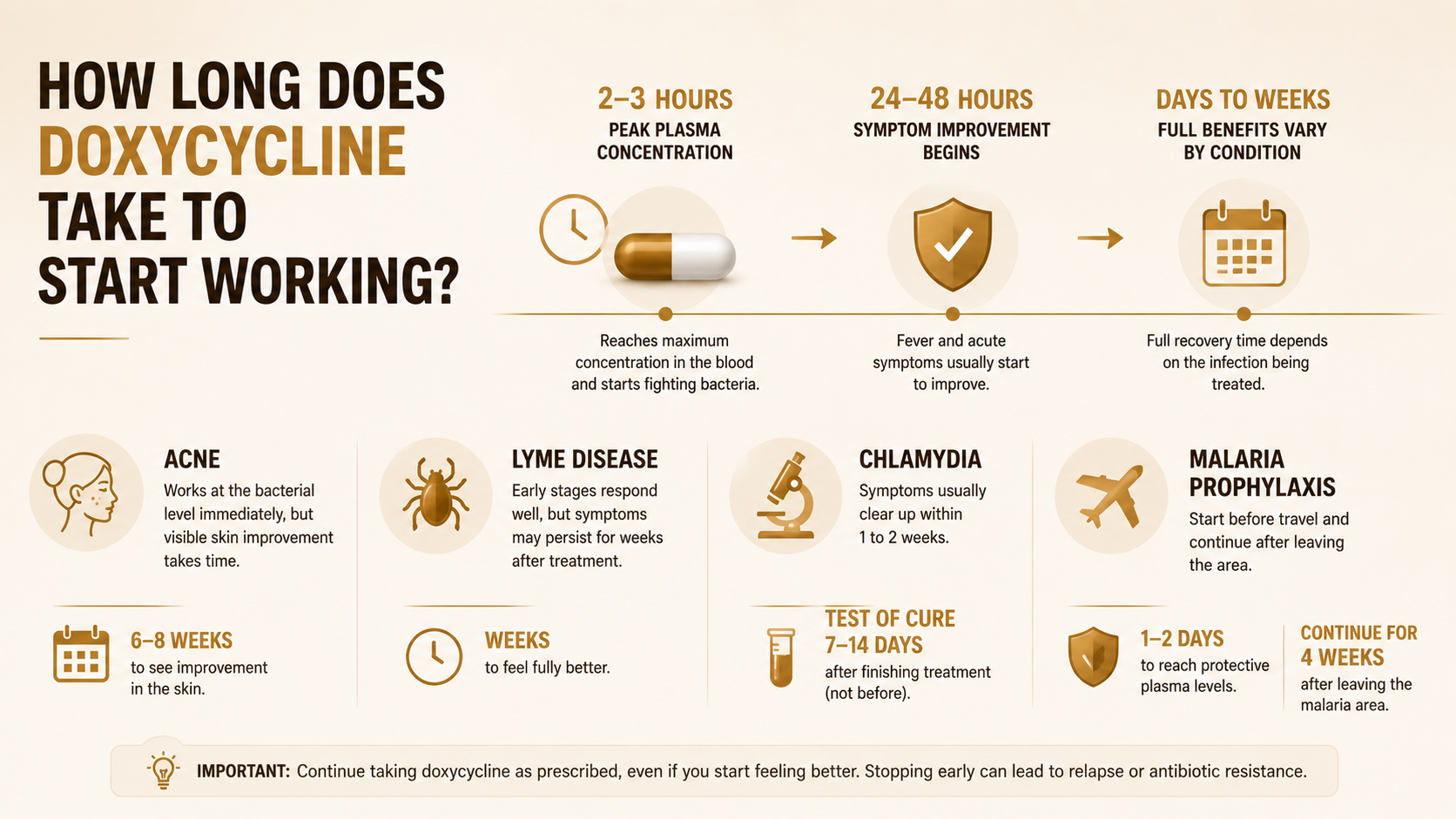
After oral treatment, the peak plasma concentration of doxycycline is achieved after 2-3 hours. By this time, it has reached its maximum concentration in the blood and is exercising its bacteriostatic action on susceptible bacteria.
Most individuals with acute illness will have a reduction in symptoms within 24 to 48 hours of beginning doxycycline. At this point, the fever and acute systemic symptoms generally begin to subside. However:
- For acne: Doxycycline works at the bacterial level and hence treats acne immediately (although acne lesions take time to heal, and new lesions that are suppressed by the antibiotic were already forming before treatment, so it usually takes 6 to 8 weeks to see improvement on the skin).
- For Lyme disease: Lyme disease in its early stages is highly responsive; however, symptoms may persist for weeks after therapy has been completed, regardless of the effectiveness of the therapy.
- For chlamydia: Symptoms of chlamydia usually clear up within 1 to 2 weeks, but you should have a test of cure 7 to 14 days after finishing your therapy, and not before then.
- For malaria prophylaxis: Must be started 1-2 days before entry into a malaria-endemic area and continued for 4 weeks after leaving the area. Protective plasma concentrations are achieved within the 1st 1-2 days of delivery
Doxycycline in Urine: Detection and Testing
Doxycycline is generally detectable in the urine for 1 to 3 days after the last dose in most healthy individuals. This is especially important for folks who have urine cultures performed to prove that an infection has cleared or for those who worry about being detected.
Doxycycline is not found on standard drug screening (e.g., urine drug testing for employment or legal purposes). It is an antibiotic and not a banned substance, and is not part of standard drug screening panels.
To determine if an infection has cleared after treatment with doxycycline, a urine culture sample should be obtained at least 48 to 72 hours after the last dosage. This period is crucial to avoid false-negative results due to residual antibiotics in the sample, which can prevent the growth of bacteria even when live bacteria are present in the body.
What Happens to Doxycycline in the Body After You Stop
Doxycycline is still shifting from tissues back into the circulation after you take your last dose before it is excreted. This is the elimination phase. It means that some tissues, especially those that concentrate doxycycline (liver, kidneys), may maintain the medicine longer than blood levels suggest.
Doxycycline is removed in urine and faeces. Doxycycline is mainly expelled in the faeces, unlike many other antibiotics, which are mainly eliminated through the kidneys. But renal impairment may limit its clearance; it does not prevent clearance altogether, as it would for a drug that relies primarily on renal excretion. This means that doxycycline does not build up in patients with kidney disease as much as some other medicines.
Doxycycline’s lipophilicity allows it to distribute into adipose tissue, where it can remain in fat storage longer than in the bloodstream. This is of clinical relevance mainly in the case of long-term, high-dose regimens in patients with high body fat percentages, and not in the case of routine 7 to 10-day therapies.
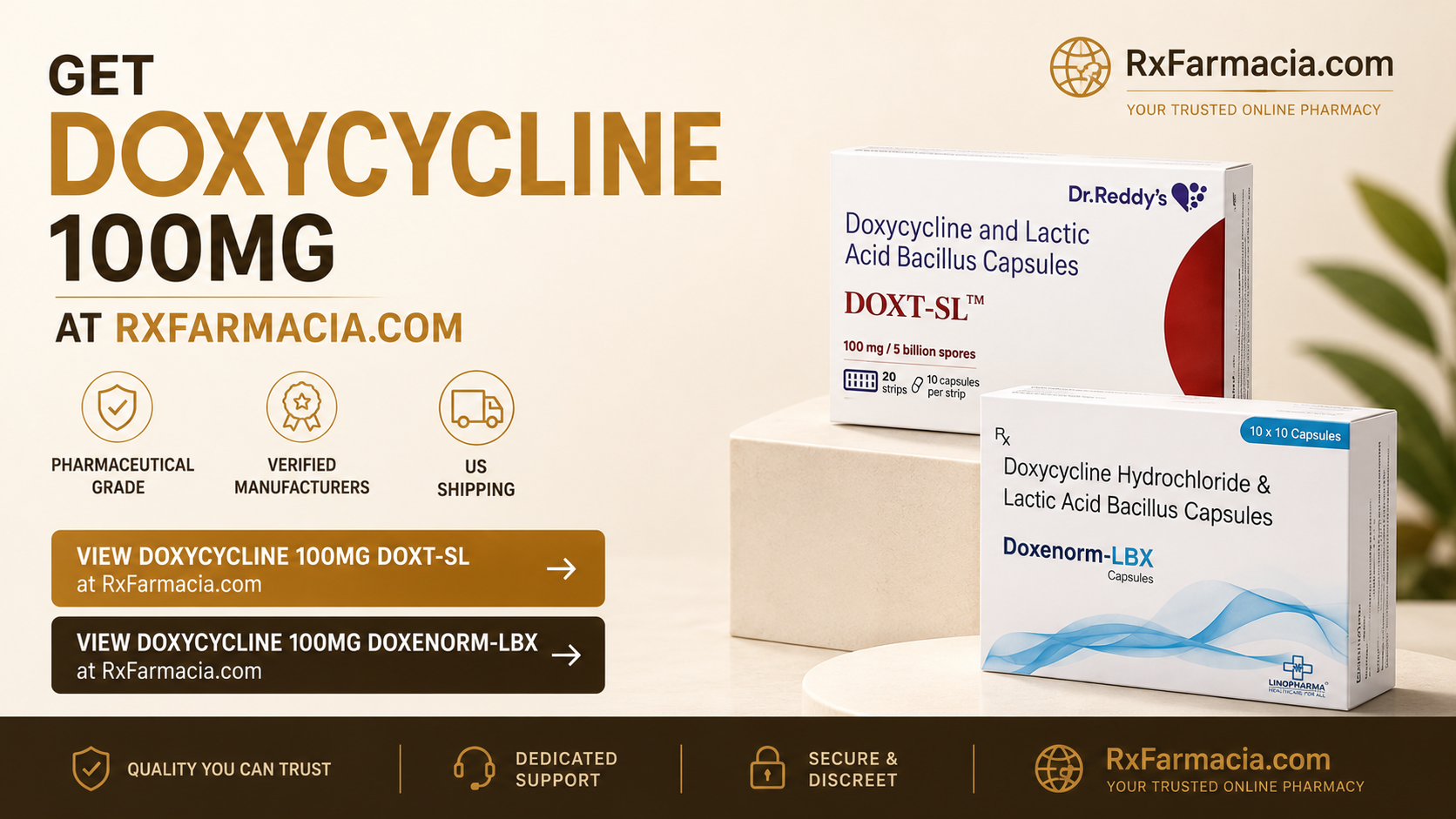
Get Doxycycline 100mg at RxFarmacia.com
RxFarmacia.com carries pharmaceutical-grade doxycycline 100mg in two formulations, both from verified manufacturers, with US shipping.
View Doxycycline 100mg Doxt-SL at RxFarmacia.com →
View Doxycycline 100mg Doxenorm-LBX at RxFarmacia.com →
Frequently Asked Questions
How long does doxycycline stay in your system?
The half-life of doxycycline in a healthy adult is 16-22 hours, with the time to full pharmacological clearance (5.5 half-lives) of around 88 to 121 hours after the previous dose (i.e., 3.5 to 5 days). The chemical may be detected in the urine for up to 72 hours, and in the blood for 3 to 5 days, depending on dose and individual characteristics such as renal function, age, and chronic alcohol use habits.
How long after doxycycline can I drink alcohol?
The clinical recommendation recommends not drinking alcohol for at least 48 hours after the last dose. 48h concentration of doxycycline is about 12.5% of the initial concentration. At this level, the pharmacokinetic interaction with alcohol and the risk of gastrointestinal amplification is not clinically significant. Alcohol should not be consumed for 72 hours in people with chronic alcohol dependence due to the altered clearance profile.
For the full doxycycline and alcohol interaction guide, see Doxycycline and alcohol at RxFarmacia.com
How long after doxycycline can I get pregnant or try to conceive?
Doxycycline is a Pregnancy Category D drug, and has been shown to cause foetal damage, especially by binding with calcium in developing foetal teeth and bones and causing permanent damage. Biological clearance of the drug takes about 5 days. Most doctors will tell you to wait at least one full menstrual cycle after you’ve completed a course of doxycycline before trying to conceive. This is to ensure that the infection has been completely cleared and to provide you with a clean slate for the pregnancy. Consult your prescriber for specific advice concerning your situation.
What is the half-life of doxycycline?
In healthy individuals with normal renal function, the half-life of doxycycline is 16 to 22 hours. For those with alcohol use disorder, this is decreased to ~10.5 hours by induction of the CYP enzyme. It is prolonged in patients with severe renal impairment, hepatic disease, and in older patients with age-related decrease in renal function.
How long does doxycycline photosensitivity last after stopping?
Photosensitivity due to doxycycline usually declines after 2 to 3 days following the last dose, when the drug reaches negligible levels in the dermal tissue. Use SPF 30 or better on all exposed skin during therapy and for 2 to 3 days following discontinuation. Avoid prolonged sun exposure. The risk of photosensitivity is far larger than for most other drugs with doxycycline.
Does doxycycline show up on a drug test?
No, routine drug testing for recreational use and drug testing for employment purposes do not screen for doxycycline. It is an antibiotic, not a controlled substance, and will not show up on regular urine drug testing panels.
How long does it take for doxycycline to clear kidney disease in patients?
In individuals with severe renal insufficiency, especially those with a creatinine clearance of less than 10 mL/min, the renal excretion of doxycycline is decreased from about 40% over 72 hours (normal function) to 1 to 5% in the same period. Elimination is by faecal excretion, but at a much lower rate. Patients with significant renal impairment should visit their doctor for advice on dose adjustments and clearance schedules.
How long after doxycycline can I take antacids or dairy?
Antacids, dairy products, calcium, magnesium, and iron supplements provided concurrently markedly decrease doxycycline absorption. It is recommended that doxycycline be taken at least 2 hours before or 6 hours after antacids or dairy, and to continue doxycycline uninterrupted before reintroduction of these medications. You can take antacids and dairy products right after you finish the doxycycline course.
The Bottom Line
Doxycycline has a half-life of 16 to 22 hours, and with the standard 5.5 half-life rule of thumb for clearance, the drug will be in the system of a healthy adult with normal renal function for 3 to 5 days after the last dose. In kidney disease, elderly age, and liver disease, this schedule is extended. Heavy use of alcohol, paradoxically, makes alcohol less effective. This is one reason why doxycycline might be less helpful in heavy drinkers.
The half-life is the basis for all specific questions about waiting times: 48 hours for alcohol, 2 to 3 days for photosensitivity, 5 days for complete physiological clearance, and at least one menstrual cycle before trying to conceive. Each number is the same half-life computation, just used against different clinical thresholds.
