

Minocycline vs Doxycycline: How Two Tetracyclines Compare and Which One Fits Your Situation

Minocycline vs Doxycycline | Genixmeds

Minocycline vs Doxycycline: How Two Tetracyclines Compare and Which One Fits Your Situation

key facts before you read
Both minocycline and doxycycline are second-generation tetracycline antibiotics that work through the same core mechanism: blocking bacterial protein synthesis by binding the 30S ribosomal subunit.
A systematic review of the clinical literature concludes that minocycline is not more effective than doxycycline for acne. Efficacy is equivalent.
Minocycline carries serious risks that doxycycline does not: drug-induced lupus, DRESS syndrome (Drug Reaction with Eosinophilia and Systemic Symptoms), autoimmune hepatitis, and a distinctive three-type skin hyperpigmentation that can be permanent.
No cases of drug-induced lupus have been reported with doxycycline. Multiple case series document it with minocycline.
Minocycline-induced hyperpigmentation (blue-grey discoloration) occurs after a minimum of 8 months of use and a cumulative dose of at least 70 grams; all reported cases met both thresholds.
Minocycline causes more vestibular side effects (dizziness, vertigo) due to its higher lipophilicity and CNS penetration; doxycycline causes more photosensitivity.
Current dermatology guidelines now explicitly prefer doxycycline over minocycline for acne, based on equivalent efficacy and a significantly safer side effect profile.
Doxycycline does not cause drug-induced lupus and does not cause the three-type hyperpigmentation that minocycline uniquely produces.

This comparison shows the clinical differences between minocycline and doxycycline in the treatment of acne, offering options for those who have had adverse effects with either drug and underlining the risks often not taken into account in prescribing discussions.

The Same Foundation, Different Risk Profiles

Minocycline and doxycycline have a similar basic mechanism of action and are both second-generation tetracyclines. Both molecules inhibit bacterial protein synthesis by binding to the 30S ribosomal subunit, preventing the binding of the aminoacyl-tRNA and thus the synthesis of proteins required for bacterial division. Both are bacteriostatic, which means they stop bacteria from multiplying, not killing them. Both rely on the immune system to clear the infection.

They differ not in mechanism but in pharmacokinetics. Minocycline is much more lipophilic than doxycycline. This single chemical property explains the vast differences between them, such as the greater penetration of minocycline into the CNS and its accumulation in adipose tissue, including sebaceous glands, the differences in side effects, and the unique risks it brings that doxycycline does not.

The Efficacy Question: Is Minocycline Stronger Than Doxycycline for Acne?

When asked about minocycline versus doxycycline, the most common question is the clinical answer is a clear no. Minocycline is not better than doxycycline for acne.

This was dealt with more specifically in a comprehensive review of clinical trials published in the American Journal of Clinical Dermatology. They concluded that minocycline is not superior to other tetracyclines, such as doxycycline, for the treatment of acne vulgaris. Both drugs at their usual doses produced comparable decreases in the number of inflammatory lesions and comparable rates of achieving clear or almost clear skin.

Much of the perception that minocycline is stronger stems from the fact that it was once prescribed for acne in higher doses and more often than doxycycline, and from the anecdotal experience of patients who have switched from one to the other. Results for acne are not significantly different for equal dosages and similar protocols.

The current guidelines favor doxycycline because of its equivalent efficacy. If two medications have the same results but one has much more risk, the safer one is preferred by default.
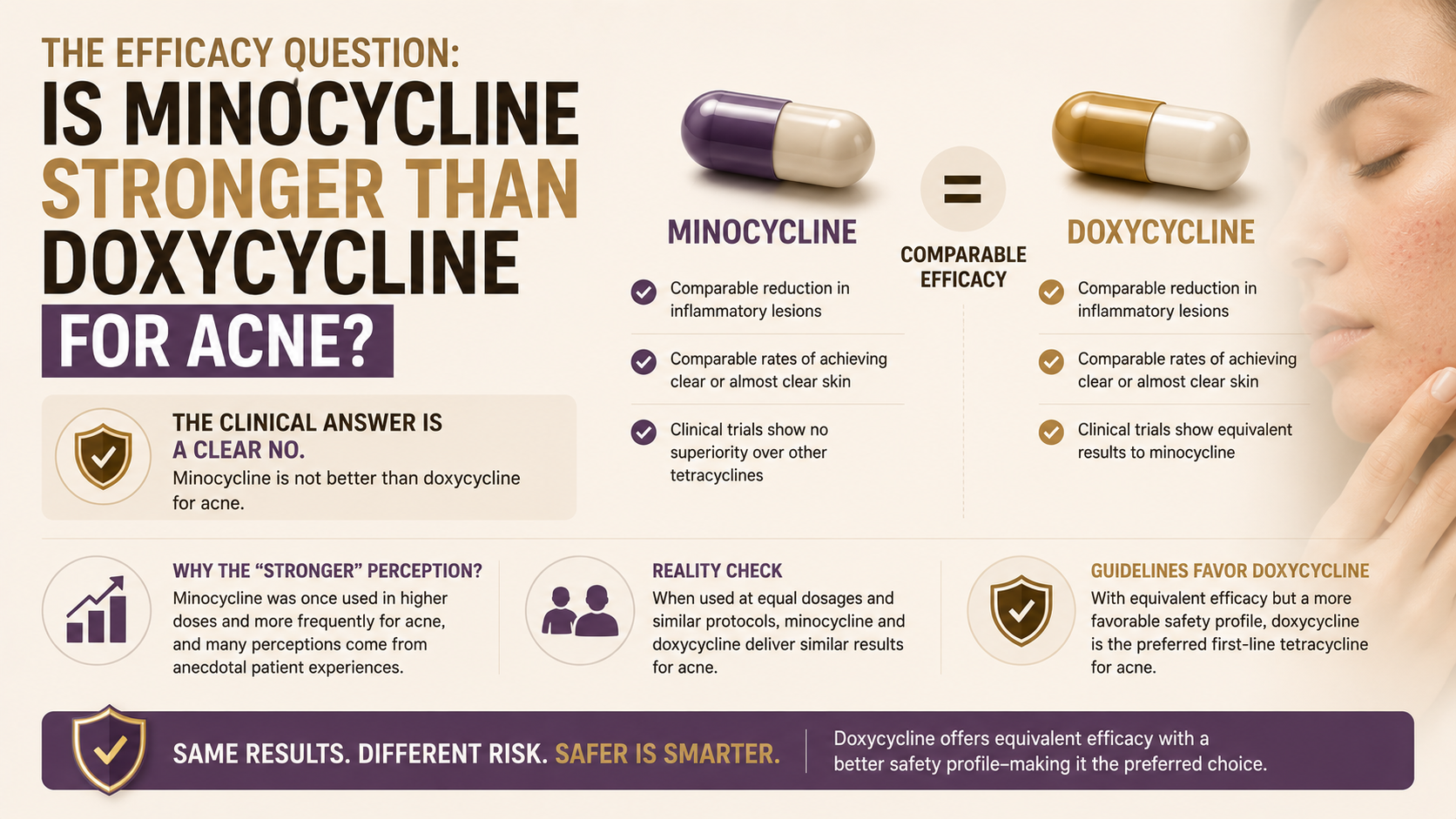
is minocycline stronger than doxycycline for acne? | RxFarmacia

What Minocycline Has That Doxycycline Does Not: The Serious Side Effects

This section is important for those who are on long-term minocycline or are thinking of starting it. These are not occasional rounding errors in the side effect profile; They are well documented, occasionally persistent, and are unique to minocycline in the tetracycline class.

Drug-Induced Lupus (Minocycline-Induced Lupus)

Minocycline-induced lupus (MIL) is an autoimmune reaction in patients on chronic minocycline therapy where the immune system produces antibodies against the body’s own tissues, resulting in a syndrome that clinically mimics systemic lupus erythematosus. It occurs with fever, rash, arthralgia, and malaise, usually after months to years of chronic use, and not during the initial phase of therapy.

The FDA prescribing information for minocycline clearly states that drug-induced lupus-like syndrome, autoimmune hepatitis and vasculitis have been associated with its use for long-term treatment of acne. The incidence of serious adverse events from minocycline requiring clinical intervention for these specific autoimmune risks is 8.8 per 100,000 patient-years, versus almost zero for doxycycline.

Importantly, there are no known reports of drug-induced lupus with doxycycline. This is not a case of doxycycline having a lower rate. There are no case series in the literature implicating doxycycline in this reaction whereas there are many such case series for minocycline.

Stopping the drug usually causes resolution of minocycline-induced lupus. The overwhelming majority of patients recover completely after minocycline discontinuation. Clinical data show that patients who develop MIL can usually be treated with doxycycline after recovery without recurrence of the autoimmune reaction. This makes doxycycline a feasible option after MIL recovery.

DRESS Syndrome

Drug Reaction with Eosinophilia and Systemic Symptoms (DRESS) is a rare, but potentially fatal, hypersensitivity reaction that may involve the liver, lungs, kidneys, or multiple organ systems at the same time. It often occurs during the initial few weeks of treatment, before autoimmune responses develop, and can be life threatening if not recognized and treated rapidly.

The FDA prescribing information for minocycline includes reports of hypersensitivity reactions, including Drug Reaction with Eosinophilia and Systemic Symptoms (DRESS). Serious complications, including hepatitis, pneumonitis, and in the worst cases, death, can occur. DRESS is not limited to minocycline in the tetracycline class, but minocycline has a higher incidence of severe adverse events, including this category, than doxycycline.

Autoimmune Hepatitis and Vasculitis

Prolonged treatment with minocycline has also been associated with vasculitis (inflammation of blood vessels) and autoimmune hepatitis (inflammation of the liver due to an immune reaction against the drug rather than infection). Both are rare but have been reported more frequently with minocycline than with doxycycline, usually requiring discontinuation of the drug and possibly corticosteroid treatment.
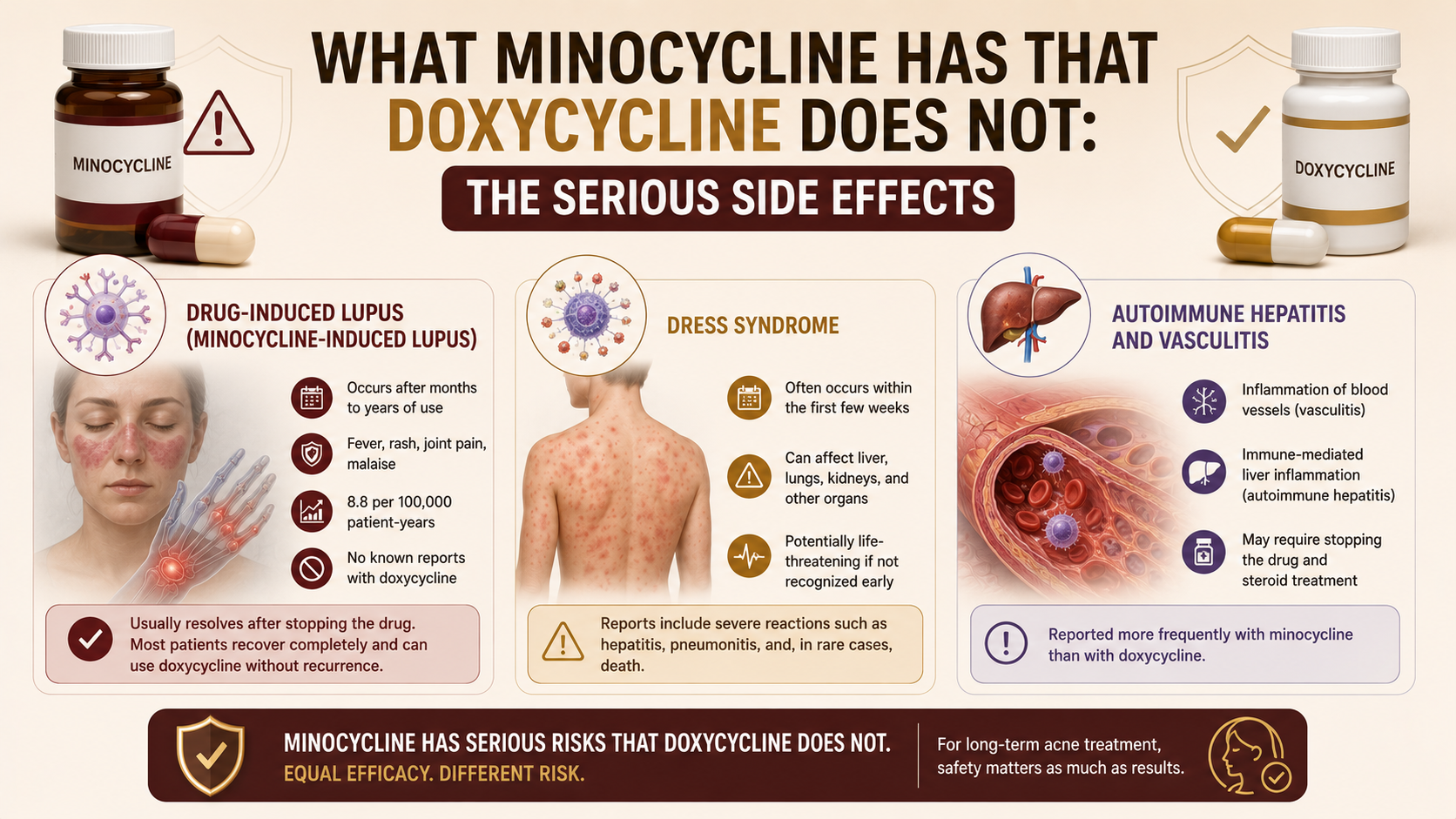
what minocycline has that doxycycline does not? | Genixmeds

Minocycline-Induced Hyperpigmentation: The Risk Most Patients Are Not Told About

This is the side effect that patients on long-term minocycline for acne most commonly encounter without prior knowledge, and it is the one that can be permanent.

Minocycline-induced hyperpigmentation presents in three distinct patterns, classified as Type I, Type II, and Type III, each with a different appearance and distribution:

type appearance location prognosis
Type 1
Blue-grey or blue-black discoloration within existing acne scars
At the base of pitted acne scars, particularly on the face
May fade slowly over months to years after stopping minocycline; some cases are permanent
Type 2
Blue-grey discoloration on otherwise normal skin
Particularly on the shins and legs; less commonly on forearms and face
Takes months to years to fade; in some cases are permanent
Type III
Diffuse muddy-brown or grey-brown discoloration
Sun-exposed areas of the body; more widespread than Types I and II
May take years to fade; one of the more stubborn presentations

All reported minocycline-induced hyperpigmentation cases were seen after at least 8 months of therapy and a cumulative dose of at least 70 grams of the drug. This is not a side effect of the first week. The longer someone uses it, the greater the risk, so it tends to happen in patients who have been using minocycline for acne for years, not months.

In some patients, laser therapy can partially reverse the hyperpigmentation caused by minocycline, but results are variable and the treatment is expensive and time-consuming. Prevention by avoiding prolonged minocycline therapy or limiting the cumulative dose is far more beneficial than treatment of established pigmentation.

This triadic hyperpigmentation pattern is not produced by doxycycline. While the prescribing information for tetracyclines as a class contains warnings about pigmentation, the specific blue-grey pigmentation reported in clinical case series with minocycline is not a finding associated with doxycycline.

What Doxycycline Has That Minocycline Does Not

The comparison is not entirely one-sided. Doxycycline carries its own distinct considerations that are clinically meaningful.

Photosensitivity

Doxycycline causes much greater photosensitivity than minocycline. This is related to the lower lipophilicity of doxycycline and the altered tissue distribution of the drug: more of the drug remains on or near the surface of the skin where it can interact with UV radiation and cause phototoxic reactions. Patients prescribed doxycycline should apply a broad spectrum SPF 30 or higher regularly to all exposed skin while on therapy and for a few days after treatment.

Minocycline is more lipophilic, meaning it concentrates in deep tissues and is less likely to be found on the skin’s surface. This is why minocycline causes photosensitivity much less often than other tetracyclines, even though it is a tetracycline.

GI Side Effects and Food Interaction

Doxycycline is more irritating to the gastrointestinal tract than minocycline including nausea and esophageal discomfort especially if taken without food or in a supine position within 30 minutes of administration. Doxycycline should be taken with food to decrease gastrointestinal side effects, but not completely eliminate them. High-fat meals may also decrease absorption to a small extent.

Also, minocycline is absorbed less affected by food and is usually considered to have fewer gastrointestinal side effects. Nonetheless, gastrointestinal symptoms can still occur.

Vestibular Side Effects

Minocycline is associated with significantly more vestibular adverse effects than doxycycline, including dizziness, vertigo and lightheadedness. This is because of its better CNS penetration due to increased lipophilicity. Vestibular effects are encountered in up to 70% of patients receiving high doses of immediate release minocycline and were the primary driver for the development of the extended release formulations (Solodyn).

In practical terms, at therapeutic doses, doxycycline has virtually no vestibular effects, which is advantageous for those who drive, operate machinery, or are prone to dizziness.
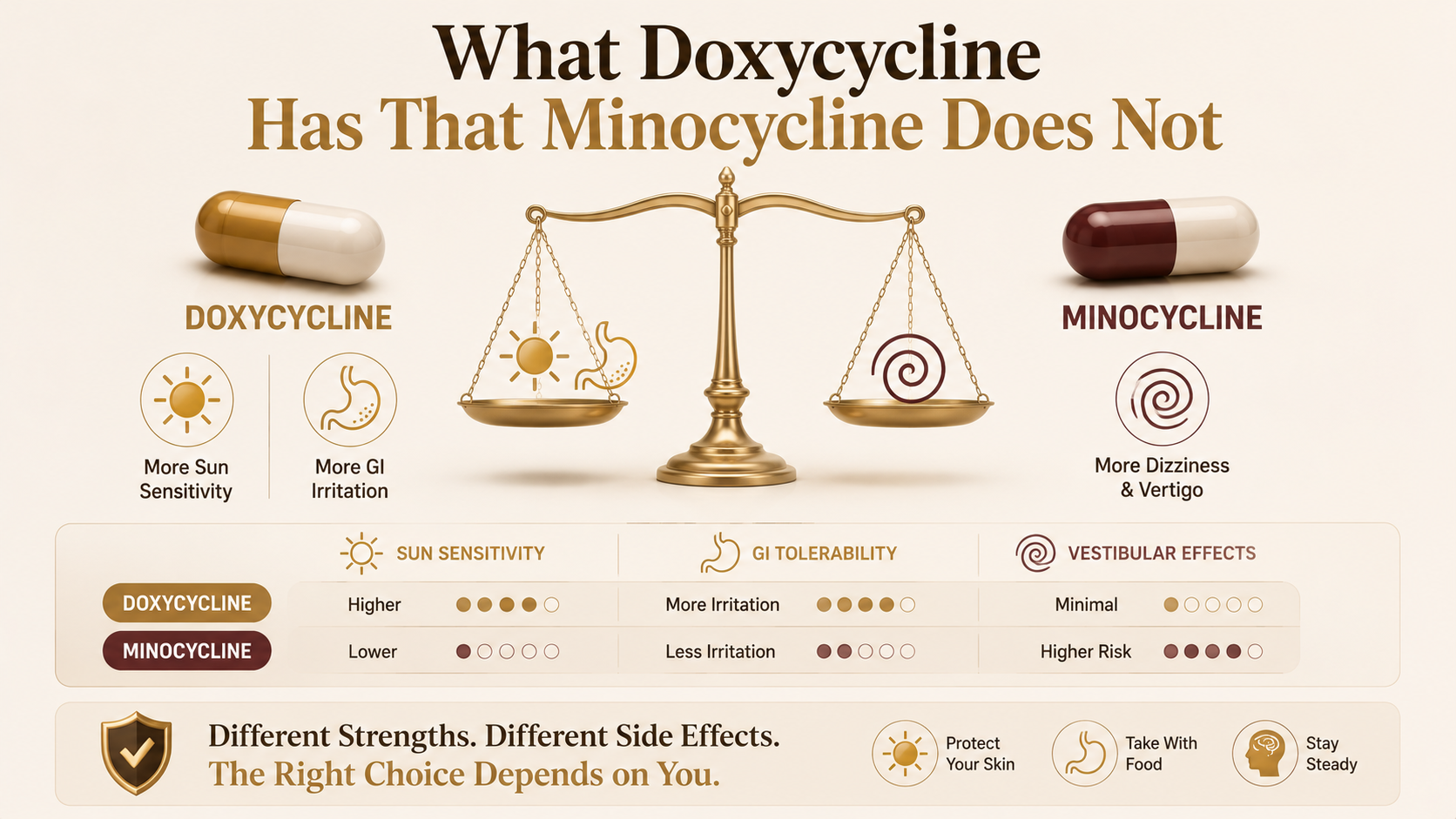
what doxycycline has that minocycline does not | RxFarmacia

The Complete Side-by-Side Comparison

feature minocycline doxycycline
Mechanism
30S ribosomal binding; bacteriostatic
Same mechanism
Acne efficacy
Equivalent to doxycycline per systematic review
Equivalent to minocycline per systematic review
Lipophilicity
High; penetrates CNS and fatty tissue readily
Lower; less CNS penetration, more skin surface concentration
Standard dosing for acne
50 to 100mg twice daily; extended-release 45 to 135mg once daily (Solodyn)
50 to 100mg once or twice daily; 100 to 200mg per day total
Food interaction
Minimal; can be taken with or without food
High-fat meals reduce absorption; GI side effects are reduced by food
Photosensitivity
Low CNS distribution means less drug at thebrainn surface
High; significant photosensitivity risk throughout treatment
GI side effects
Milder overall; nausea still possible
More common; esophageal irritation risk; take with food and water
Vestibular side effects (dizziness, vertigo)
Common, especially at higher doses; up to 70% at high doses
Essentially absent at therapeutic doses
Drug-induced lupus
Documented; multiple case series; rare but real
No cases reported in the available literature
DRESS syndrome
Documented; rare but potentially serious
Documented; class effect but less commonly reported
Minocycline-type hyperpigmentation (Types I, II, III)
Yes; after 8+ months and 70g+ cumulative dose; can be permanent
No; does not produce this three-type pattern
Autoimmune hepatitis
Associated with long-term use
Not specifically associated
Photosensitivity-related sunburn
Low risk
Significant; requires strict SPF throughout the course
Current guideline preference for acne
Less preferred due to serious side effect profile
Preferred; equivalent efficacy with a safer profile
Generic availability and cost
Widely available; affordable

What Current Guidelines Say

The shift in clinical guideline preference from minocycline to doxycycline in acne treatment has been slow but steady throughout dermatology literature in the 2020s.

A clinical review published in 2026 in Dermatology Times found that minocycline had the highest serious adverse event incidence among tetracyclines at 8.8 events per 100,000 patient years. Doxycycline has therefore become the tetracycline of choice in guidelines for acne on the basis of comparable efficacy and lower serious risks.

A systematic review in The American Journal of Clinical Dermatology found that minocycline is no more effective for acne than other tetracyclines and carries an increased risk of serious side effects, including autoimmune disorders, central nervous system symptoms, and hyperpigmentation, which is not seen with doxycycline.

This is not to say that minocycline should be categorically contraindicated for prescription. Doxycycline is the preferred agent for the majority of patients with acne who require oral tetracycline. The transition from minocycline to doxycycline, about the specific side effects discussed herein, is clinically appropriate and consistent with guidelines.

When Minocycline May Still Make Sense

Its side effect profile is more complicated, but in some clinical settings minocycline may still be the better choice.

  • The reduced photosensitivity risk associated with minocycline could be a major benefit for patients who have significant photosensitivity and spend a lot of time outdoors and cannot reliably apply SPF.
  • Patients with a history of significant gastrointestinal intolerance or esophageal irritation, with proper administration techniques of doxycycline
  • Patients with particular infection patterns for which a clinician has a clinical rationale to favor minocycline’s tissue distribution characteristics
  • Short, restricted courses with far less risk of hyperpigmentation and autoimmune effects, which take months to years to manifest.

Minocycline is absolutely contraindicated in patients with a personal or family history of lupus or other autoimmune conditions, previous development of minocycline-induced lupus or hyperpigmentation, or those who are already at increased risk for liver disease because of the association with autoimmune hepatitis.

Get Doxycycline 100mg at RxFarmacia.com

RxFarmacia.com carries pharmaceutical-grade doxycycline 100mg in two formulations, both from verified WHO-GMP manufacturers, with US shipping.

View Doxycycline 100mg Doxt-SL at RxFarmacia.com

View Doxycycline 100mg Doxenorm-LBX at RxFarmacia.com

Frequently Asked Questions

Is minocycline stronger than doxycycline for acne?

No. A systematic review of the clinical literature shows no advantage of minocycline over doxycycline in the treatment of acne vulgaris. Head-to-head studies at the same dose levels showed similar reductions in inflammatory lesion counts and similar clear or almost clear skin rates. In many cases, the perception of increased potency of minocycline is due to prior differences in dosing protocols rather than true pharmacological superiority.

What are the side effects of minocycline that doxycycline does not have?

Three major side effects of minocycline not seen with doxycycline are drug-induced lupus (minocycline-induced lupus) with arthralgias, rash, fever, and malaise usually seen with long-term use; minocycline-induced hyperpigmentation, which can be in three different forms (blue-grey in acne scars, blue-grey on normal skin, especially on shin, and diffuse muddy-brown on sun-exposed skin) and may be permanent; and autoimmune hepatitis with long-term use. Minocycline produces significantly more vestibular adverse effects (dizziness, vertigo) than doxycycline.

Can doxycycline cause lupus?

There are no reports of doxycycline-induced lupus in the clinical literature that has been published. One major difference between doxycycline and minocycline is that drug-induced lupus is a known risk associated with minocycline but not with doxycycline. Some clinical case reports suggest that patients who developed minocycline-induced lupus were subsequently successfully treated with doxycycline, with no recurrence of the autoimmune reaction.

What is minocycline-induced hyperpigmentation?

Minocycline-induced hyperpigmentation is a skin discolouration that occurs after long-term minocycline treatment, typically after at least 8 months of therapy and a total dose of at least 70 g. It has been classified into three types; blue-gray discoloration in acne scars (Type I), blue-gray discoloration on normal skin (especially shins) (Type II) and diffuse muddy-brown discoloration on sun-exposed areas (Type III). All three types can be permanent or may take months to years to resolve even after minocycline is discontinued. This triadic pattern of hyperpigmentation is not due to doxycycline.

Which is better for acne, minocycline or doxycycline?

Doxycycline is recommended for acne by current dermatologic guidelines because it has similar clinical efficacy but a much safer side effect profile. The use of minocycline does not result in better acne outcomes than doxycycline at similar doses and has unique risks of drug induced lupus and permanent skin hyperpigmentation that are not seen with doxycycline. For most patients requiring an oral tetracycline for acne, doxycycline is better supported as the initial choice.

Does minocycline cause more photosensitivity than doxycycline?

No, quite the opposite. Doxycycline is much more phototoxic than minocycline. Doxycycline is less lipophilic, so more of the drug stays on the surface of the skin and can interact with UV radiation. If you are taking doxycycline, you should always wear sunscreen with SPF 30 or higher. Minocycline is much less phototoxic and more lipophilic and therefore accumulates in deep tissues.

The Bottom Line

Minocycline and doxycycline are equally effective tetracyclines to treat acne. There is no clinical superiority of efficacy between the two. Doxycycline alone is the more justifiable choice in most patients when side effects alone are compared.

Minocycline has risks not seen with doxycycline: drug-induced lupus, a characteristic kind of permanent hyperpigmentation of the skin that occurs with long-term use of minocycline, and vestibular side effects, because minocycline crosses the blood-brain barrier more easily. These are significant additional risks for similar acne outcomes.

If you are taking minocycline and notice any unusual skin discoloration, joint related symptoms, or persistent dizziness, you should let your prescriber know, especially because minocycline has known risks. Clinical evidence and modern dermatological protocols strongly support the switch to doxycycline.

Medical Disclaimer: This article is for informational purposes only and does not constitute medical advice. Both minocycline and doxycycline are prescription medications. Do not start, stop, or switch between antibiotics without guidance from a licensed healthcare provider. If you are experiencing symptoms that may be related to minocycline use, including joint pain, skin discoloration, or dizziness, contact your prescriber.

Leave a Reply

Your email address will not be published. Required fields are marked *